

Circles appear everywhere. Wheels, clocks, coins, pipes, plates, planets, and round buildings all depend on circle geometry. Although a circle looks simple, it connects several important ideas in mathematics.
Three of the most useful concepts are the unit circle, the area of a circle, and the circumference of a circle.
The area tells us how much Space is inside a circle. The circumference tells us the total distance around it. The unit circle helps us understand angles, coordinates, sine, cosine, and trigonometry.
These topics may seem separate at first, but they are closely related. They all depend on the radius, the center of the circle, and the mathematical constant π, pronounced “pi.”
This guide explains each concept using simple language, formulas, examples, and practical tips.
What Is a Circle? Understanding the Basic Parts
A circle is a flat, round shape made from all points that are the same distance from one fixed point.
That fixed point is called the center.
The distance from the center to any point on the circle is called the radius.
Before learning circle formulas, it is important to understand the main parts of a circle.
Center
The center is the exact middle point of the circle.
In coordinate geometry, the center may be written as:
[
(h,k)
]
For a circle centered at the origin, the center is:
[
(0,0)
]
The unit circle is always centered at the origin unless stated otherwise.
Radius
The radius is the distance from the center to the outside edge of the circle.
It is normally represented by the letter:
[
r
]
Every radius in the same circle has the same length.
For example, when a circle has a radius of 5 centimeters, every point on the circle is exactly 5 centimeters from the center.
Diameter
The diameter is a straight line that passes through the center and connects two points on the circle.
It is represented by:
[
d
]
The diameter is twice the radius:
[
d=2r
]
The radius is half the diameter:
[
r=\frac{d}{2}
]
If a circle has a radius of 6 inches, its diameter is:
[
d=2(6)=12\text{ inches}
]
Circumference
The circumference is the total distance around the outside of a circle.
It performs the same role as perimeter does for shapes such as squares and rectangles.
Area
The area is the total amount of flat Space inside a circle.
Area is measured in square units, such as:
- Square centimeters
- Square meters
- Square inches
- Square feet
Pi
Pi is one of the most important numbers in circle mathematics.
It is written using the Greek symbol:
[
\pi
]
Its approximate value is:
[
\pi\approx3.14159
]
For many basic calculations, people use:
[
\pi\approx3.14
]
Pi represents the ratio between a circle’s circumference and its diameter.
For every circle:
[
\frac{\text{circumference}}{\text{diameter}}=\pi
]
This relationship remains true whether the circle is extremely small or extremely large.
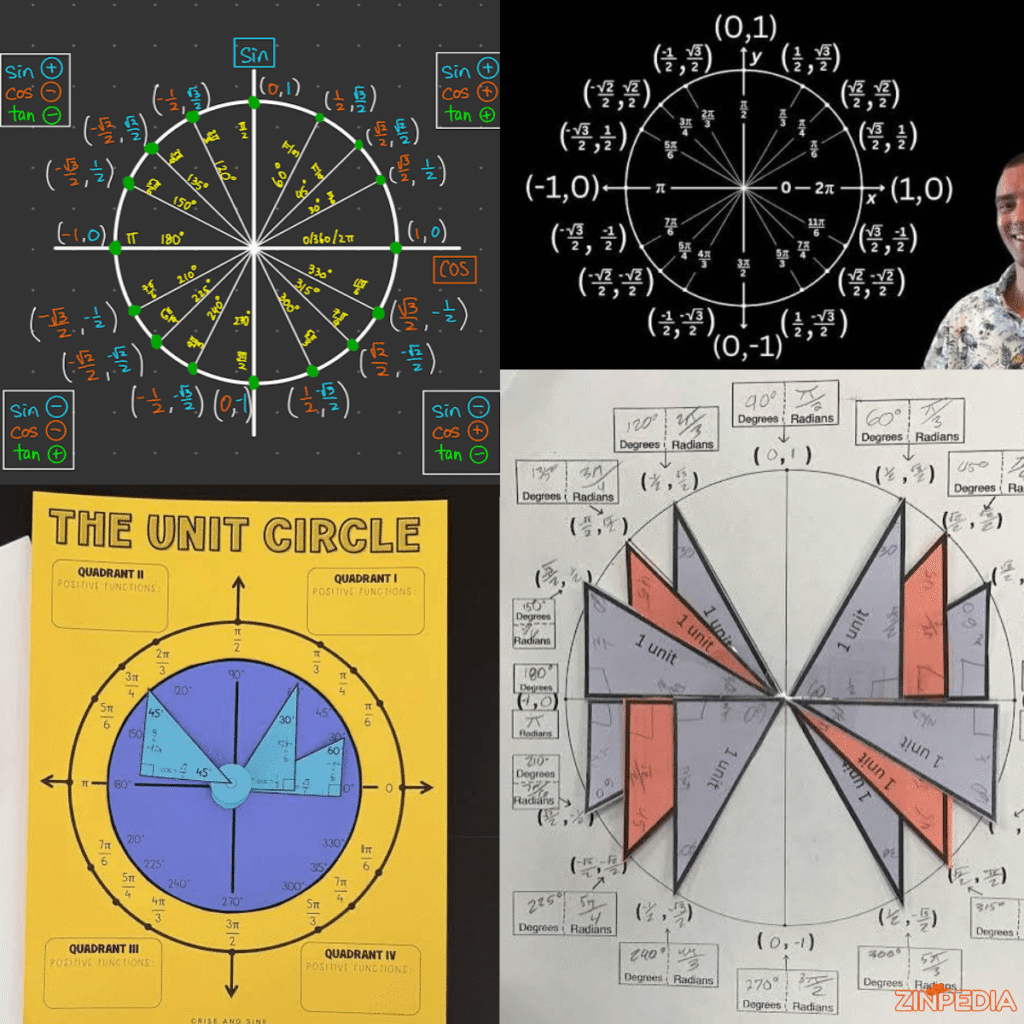
What Is the Unit Circle?
The unit circle is a circle with a radius of exactly 1 unit.
It is centered at the origin of a coordinate plane:
[
(0,0)
]
Because its radius is 1, the unit circle has the equation:
[
x^2+y^2=1
]
The name “unit circle” comes from its radius. A unit is simply one measurement so that the radius may be thought of as 1 meter, 1 centimeter, or one abstract mathematical unit.
Why is the unit circle important?
The unit circle is essential in trigonometry because it connects:
- Angles
- Coordinates
- Sine
- Cosine
- Tangent
- Degrees
- Radians
- Rotations
- Periodic motion
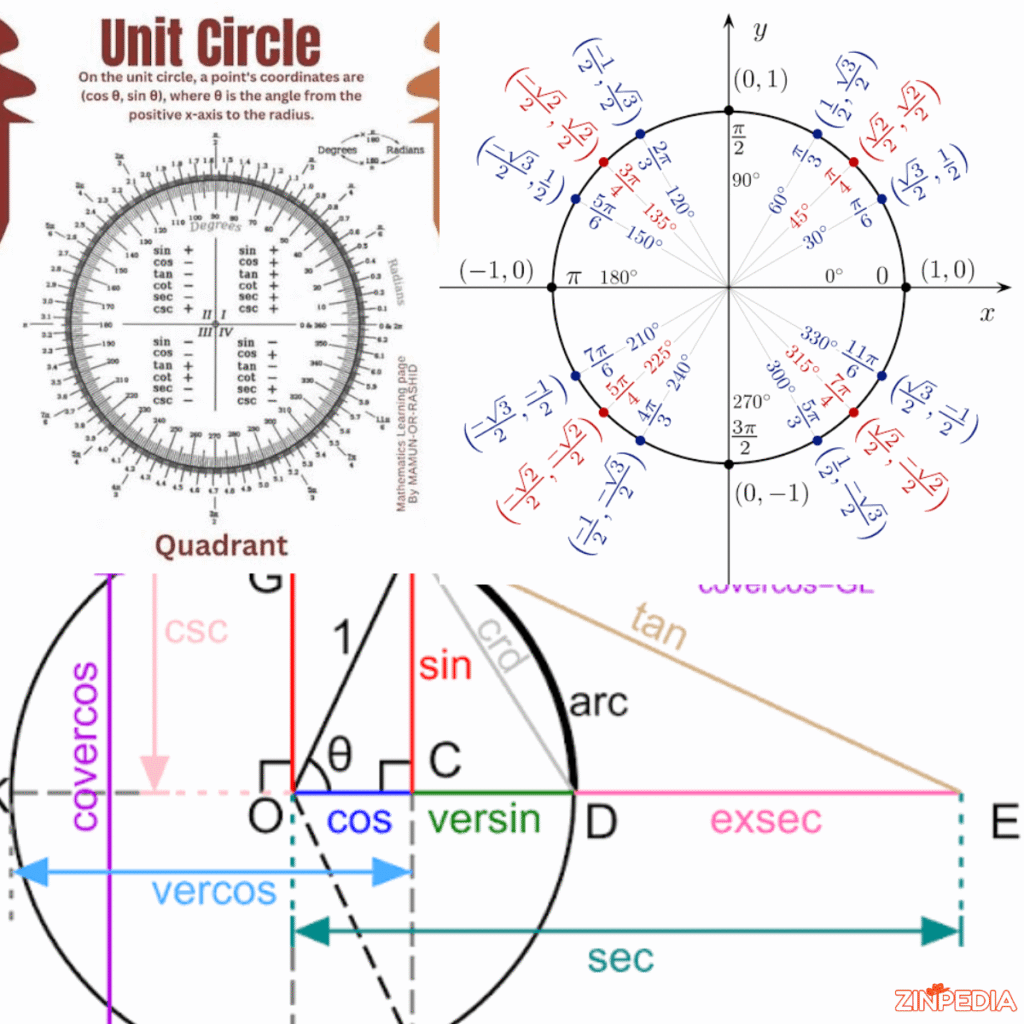
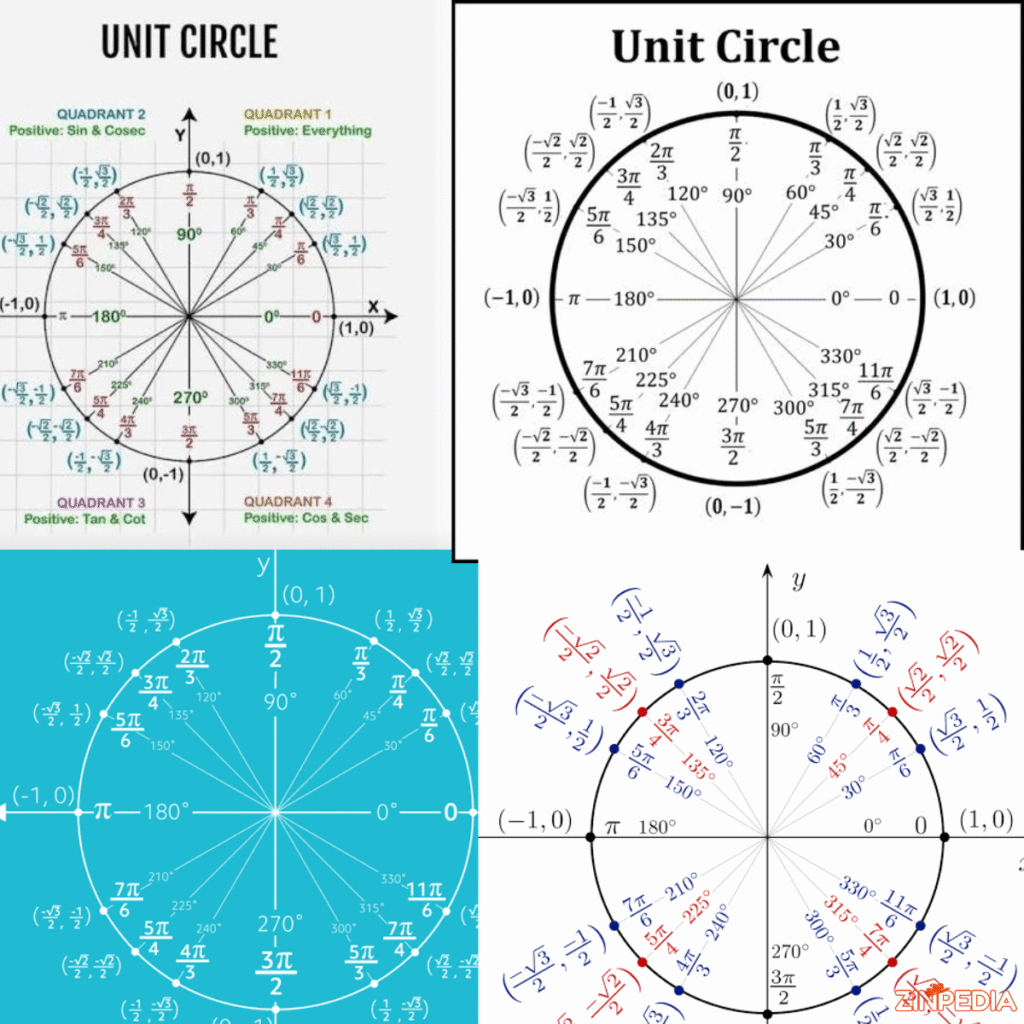
When an angle is drawn from the positive x-axis, the point where the angle meets the unit circle has coordinates:
[
(\cos\theta,\sin\theta)
]
This means:
- The x-coordinate equals the cosine of the angle.
- The y-coordinate equals the sine of the angle.
For example, at an angle of 0 degrees, the point on the unit circle is:
[
(1,0)
]
Therefore:
[
\cos0^\circ=1
]
and:
[
\sin0^\circ=0
]
At 90 degrees, the point is:
[
(0,1)
]
Therefore:
[
\cos90^\circ=0
]
and:
[
\sin90^\circ=1
]
The four quadrants
The coordinate plane is divided into four sections called quadrants.
Quadrant I
Angles between 0 and 90 degrees lie in Quadrant I.
Both x and y are positive.
Therefore:
- Cosine is positive.
- Sine is positive.
- Tangent is positive.
Quadrant II
Angles between 90 and 180 degrees lie in Quadrant II.
Here:
- x is negative.
- y is positive.
Therefore:
- Cosine is negative.
- Sine is positive.
- Tangent is negative.
Quadrant III
Angles between 180 and 270 degrees lie in Quadrant III.
Both x and y are negative.
Therefore:
- Cosine is negative.
- Sine is negative.
- Tangent is positive.
Quadrant IV
Angles between 270 and 360 degrees lie in Quadrant IV.
Here:
- x is positive.
- y is negative.
Therefore:
- Cosine is positive.
- Sine is negative.
- Tangent is negative.
A useful memory pattern is:
- Quadrant I: all are positive.
- Quadrant II: sine is positive.
- Quadrant III: tangent is positive.
- Quadrant IV: cosine is positive.
Important unit circle values
Some angles appear repeatedly in trigonometry.
DegreesRadiansCoordinates ((\cos\theta,\sin\theta))
0° 0 ((1,0))
30° (\frac{\pi}{6}) (\left(\frac{\sqrt3}{2},\frac12\right))
45° (\frac{\pi}{4}) (\left(\frac{\sqrt2}{2},\frac{\sqrt2}{2}\right))
60° (\frac{\pi}{3}) (\left(\frac12,\frac{\sqrt3}{2}\right))
90° (\frac{\pi}{2}) ((0,1))
180° (\pi) ((-1,0))
270° (\frac{3\pi}{2}) ((0,-1))
360° (2\pi) ((1,0))
The coordinates repeat in different quadrants, but their signs change.
For example, the reference angle for both 30 degrees and 150 degrees is 30 degrees.
At 30 degrees:
[
\left(\frac{\sqrt3}{2},\frac12\right)
]
At 150 degrees, the point is in Quadrant II, so cosine is negative, and sine is positive:
[
\left(-\frac{\sqrt3}{2},\frac12\right)
]
Degrees and Radians on the Unit Circle
Angles can be measured in degrees or radians.
Most people first learn degrees:
- One full circle equals 360 degrees.
- Half a circle equals 180 degrees.
- One quarter of a circle equals 90 degrees.
Radians measure angles using the radius and arc length of a circle.
One full circle equals:
[
2\pi\text{ radians}
]
Therefore:
[
360^\circ=2\pi
]
Half a circle equals:
[
180^\circ=\pi
]
A quarter circle equals:
[
90^\circ=\frac{\pi}{2}
]
Converting degrees to radians
To convert degrees to radians, multiply by:
[
\frac{\pi}{180}
]
Formula:
[
\text{Radians}=\text{Degrees}\times\frac{\pi}{180}
]
Example: Convert 60 degrees to radians.
[
60\times\frac{\pi}{180}
]
Simplify:
[
\frac{60\pi}{180}=\frac{\pi}{3}
]
Therefore:
[
60^\circ=\frac{\pi}{3}
]
Converting radians to degrees
To convert radians to degrees, multiply by:
[
\frac{180}{\pi}
]
Formula:
[
\text{Degrees}=\text{Radians}\times\frac{180}{\pi}
]
Example: Convert (\frac{3\pi}{4}) radians to degrees.
[
\frac{3\pi}{4}\times\frac{180}{\pi}
]
Cancel (\pi):
[
\frac{3\times180}{4}=135
]
Therefore:
[
\frac{3\pi}{4}=135^\circ
]
Why radians matter
Radians are widely used in advanced mathematics, physics, engineering, and calculus.
They make many formulas simpler because radians are based directly on the geometry of a circle.
For example, arc length is calculated using:
[
s=r\theta
]
where:
- (s) is arc length.
- (r) is the radius.
- (\theta) is the angle in radians.
On the unit circle, the radius equals 1, so:
[
s=\theta
]
This means the angle in radians equals the arc length traveled around the unit circle.
How to Find the Circumference of a Circle
The circumference is the distance around a circle.
There are two common circumference formulas.
When the radius is known:
[
C=2\pi r
]
When the diameter is known:
[
C=\pi d
]
These formulas are equal because:
[
d=2r
]
Circumference example using radius
Suppose a circle has a radius of 7 centimeters.
Use:
[
C=2\pi r
]
Substitute 7 for (r):
[
C=2\pi(7)
]
[
C=14\pi
]
The exact answer is:
[
14\pi\text{ cm}
]
Using (\pi\approx3.14):
[
C\approx14(3.14)
]
[
C\approx43.96\text{ cm}
]
Circumference example using diameter
Suppose a circular table has a diameter of 10 feet.
Use:
[
C=\pi d
]
Substitute 10:
[
C=10\pi
]
Using (\pi\approx3.14):
[
C\approx31.4\text{ feet}
]
This means the distance around the edge of the table is approximately 31.4 feet.
Circumference of the unit circle
The radius of the unit circle is 1.
Use:
[
C=2\pi r
]
Substitute (r=1):
[
C=2\pi(1)
]
[
C=2\pi
]
Therefore, the circumference of the unit circle is:
[
2\pi\text{ units}
]
This result explains why one complete rotation around the unit circle equals (2\pi) radians.
Real-life circumference example
Imagine a bicycle wheel with a radius of 14 inches.
The circumference is:
[
C=2\pi(14)
]
[
C=28\pi
]
Using 3.14:
[
C\approx87.92\text{ inches}
]
The wheel moves approximately 87.92 inches forward during one full rotation, assuming it does not slip.
Circumference calculations are useful for:
- Wheels
- Pipes
- Circular tracks
- Round gardens
- Coins
- Cables wrapped around circular objects
- Circular buildings
- Manufacturing round parts
How to Calculate the Area of a Circle
The area of a circle measures the Space inside it.
The formula is:
[
A=\pi r^2
]
where:
- (A) is area.
- (r) is the radius.
- (r^2) means radius multiplied by itself.
Area example using radius
Suppose a circle has a radius of 5 meters.
Use:
[
A=\pi r^2
]
Substitute 5:
[
A=\pi(5)^2
]
[
A=25\pi
]
The exact answer is:
[
25\pi\text{ m}^2
]
Using (\pi\approx3.14):
[
A\approx25(3.14)
]
[
A\approx78.5\text{ m}^2
]
Area example using diameter
Suppose a circular rug has a diameter of 12 feet.
The area formula requires the radius, so first divide the diameter by 2:
[
r=\frac{12}{2}=6
]
Now use:
[
A=\pi r^2
]
[
A=\pi(6)^2
]
[
A=36\pi
]
Using 3.14:
[
A\approx113.04\text{ ft}^2
]
Area of the unit circle
The radius of the unit circle equals 1.
Use:
[
A=\pi r^2
]
[
A=\pi(1)^2
]
[
A=\pi
]
Therefore, the area of the unit circle is:
[
\pi\text{ square units}
]
Why is the radius squared?
Area is measured in square units because it represents two-dimensional Space.
When the radius doubles, the area does not merely double.
For example:
A circle with radius 2 has area:
[
A=\pi(2)^2=4\pi
]
A circle with radius 4 has area:
[
A=\pi(4)^2=16\pi
]
The radius doubled from 2 to 4, but the area became four times larger.
This happens because:
[
(2r)^2=4r^2
]
Understanding this relationship is useful in design, construction, landscaping, and engineering.
Area vs Circumference: Key Differences
Area and circumference are often confused because both involve circles and π.
However, they measure different things.
FeatureAreaCircumference
Meaning Space inside a circle Distance around a circle
Formula (A=\pi r^2) (C=2\pi r)
Measurement Square units Linear units
Example units cm², m², ft² cm, m, ft
Uses radius squared? Yes No
Example comparison
Consider a circle with radius 3 centimeters.
Circumference:
[
C=2\pi(3)=6\pi
]
[
C\approx18.84\text{ cm}
]
Area:
[
A=\pi(3)^2=9\pi
]
[
A\approx28.26\text{ cm}^2
]
The numbers and units are different because they measure different properties.
A simple way to remember
Use this memory guide:
- Circumference means circling the edge.
- Area means the amount inside.
- Circumference uses (r).
- Area uses (r^2).
Never write square units for circumference.
Never forget square units for area.
Common Circle Mistakes and How to Avoid Them
Circle problems are usually straightforward, but small mistakes can lead to incorrect answers.
Confusing radius with diameter
The diameter is twice the radius.
If the diameter is 18 centimeters, the radius is:
[
r=9\text{ cm}
]
Do not substitute 18 into the area formula unless 18 is actually the radius.
Forgetting to square the radius
The area formula is:
[
A=\pi r^2
]
It is not:
[
A=\pi r
]
For a radius of 4:
[
r^2=4^2=16
]
Squaring the wrong part
The formula means square the radius, not π.
Correct:
[
A=\pi(5^2)=25\pi
]
Not:
[
A=\pi^2(5)
]
Using the wrong units
Circumference is measured in standard length units:
[
\text{cm, m, ft, in}
]
Area is measured in square units:
[
\text{cm}^2,\text{ m}^2,\text{ ft}^2,\text{ in}^2
]
Rounding too early
Keep π in the calculation until the final step.
For example:
[
A=49\pi
]
Then calculate the decimal.
Rounding at the beginning may make the final answer less accurate.
Mixing degrees and radians
Before solving a trigonometry or arc-length problem, check whether the angle is given in degrees or radians.
The formula:
[
s=r\theta
]
requires (\theta) to be in radians.
Forgetting unit circle signs
The reference values may be correct, but the signs depend on the quadrant.
For example, 45 degrees and 225 degrees use the same basic coordinate values.
At 45 degrees:
[
\left(\frac{\sqrt2}{2},\frac{\sqrt2}{2}\right)
]
At 225 degrees, both coordinates are negative:
[
\left(-\frac{\sqrt2}{2},-\frac{\sqrt2}{2}\right)
]
Frequently Asked Questions About Circles
What is the unit circle?
The unit circle is a circle with radius 1 centered at (0,0). Its equation is:
[
x^2+y^2=1
]
It is used to understand sine, cosine, tangent, radians, and angles.
What is the formula for the area of a circle?
The formula is:
[
A=\pi r^2
]
Multiply the radius by itself, then multiply by π.
What is the circumference formula?
When the radius is known:
[
C=2\pi r
]
When the diameter is known:
[
C=\pi d
]
What is the difference between area and circumference?
Area measures the Space inside the circle. Circumference measures the distance around it.
Why is pi used in circle formulas?
Pi represents the constant ratio between a circle’s circumference and its diameter. This ratio is the same for every circle.
What is the area of the unit circle?
Because the radius is 1:
[
A=\pi(1)^2=\pi
]
The area is (\pi) square units.
What is the circumference of the unit circle?
Because the radius is 1:
[
C=2\pi(1)=2\pi
]
The circumference is (2\pi) units.
How do I find the radius from circumference?
Start with:
[
C=2\pi r
]
Divide both sides by (2\pi):
[
r=\frac{C}{2\pi}
]
For example, if the circumference is (20\pi):
[
r=\frac{20\pi}{2\pi}=10
]
How do I find the radius from area?
Start with:
[
A=\pi r^2
]
Divide by π:
[
r^2=\frac{A}{\pi}
]
Then take the square root:
[
r=\sqrt{\frac{A}{\pi}}
]
Is the unit circle only used in geometry?
No. It is used in:
- Trigonometry
- Calculus
- Physics
- Engineering
- Computer graphics
- Waves and sound
- Rotational motion
- Electrical systems
- Navigation
Conclusion
The unit circle, area, and circumference are three connected parts of circle mathematics.
The unit circle has a radius of 1 and helps explain angles, coordinates, sine, cosine, and radians. Every point on it can be written as:
[
(\cos\theta,\sin\theta)
]
The circumference measures the distance around a circle:
[
C=2\pi r
]
or:
[
C=\pi d
]
The area measures the Space inside a circle:
[
A=\pi r^2
]
The most important step in circle problems is identifying what information is given and what the question is asking. Check whether you have the radius or diameter. Decide whether you need area, circumference, coordinates, degrees, or radians. Then choose the correct formula and include the proper units.
With regular practice, these formulas become easy to remember. More importantly, understanding why they work makes advanced topics in geometry, trigonometry, science, and engineering much easier to learn.
Explore More Helpful Articles– Visit Now