
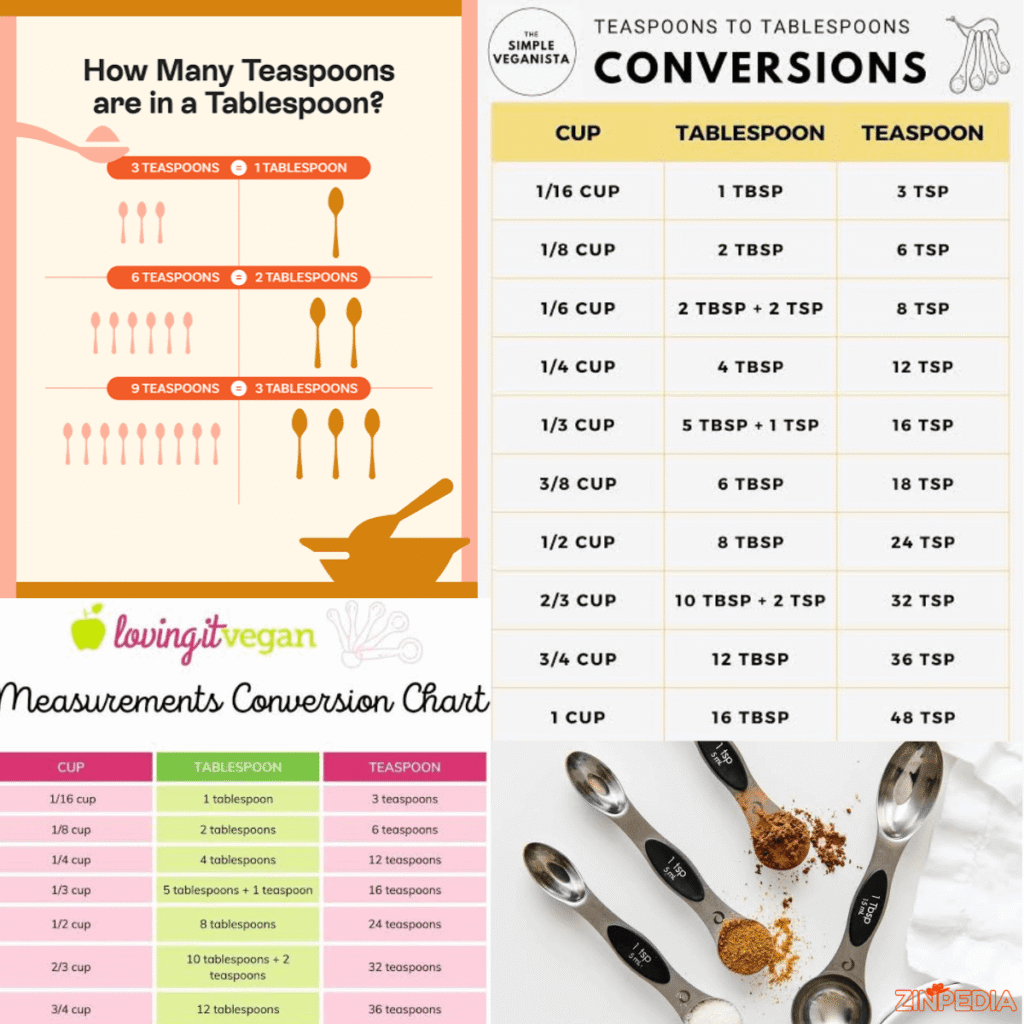
If you are in the middle of cooking and suddenly realize you cannot find your tablespoon, there is an easy solution. Just use your teaspoon instead.
1 tablespoon = 3 teaspoons
That simple conversion works for standard U.S. kitchen measurements. The National Institute of Standards and Technology (NIST) lists a teaspoon at approximately 5 mL and a tablespoon at approximately 15 mL for everyday cooking conversions, giving the familiar 3-to-1 relationship.
So, if a recipe calls for one tablespoon of sugar, oil, vanilla, flour, or another ingredient, you can measure 3 teaspoons instead.
But there are a few details worth knowing. How many teaspoons make half a tablespoon? What about two tablespoons? Are liquid and dry ingredients converted differently? And does a tablespoon mean the same thing in every country?
This guide answers all of those questions with simple formulas, practical examples, and quick-reference conversion charts.
How Many Teaspoons Are in a Tablespoon?
For standard U.S. cooking measurements:
1 tablespoon = 3 teaspoons
The abbreviations are usually written as:
- tbsp = tablespoon
- tsp = teaspoon
Therefore:
1 tbsp = 3 tsp
This relationship stays the same whether you are measuring a liquid or a dry ingredient by volume.
For example, if a recipe requires:
1 tablespoon of olive oil
but you only have a teaspoon, measure:
3 teaspoons of olive oil
Similarly:
1 tablespoon of sugar = 3 teaspoons of sugar by volume
1 tablespoon of vanilla extract = 3 teaspoons of vanilla extract
1 tablespoon of baking powder = 3 teaspoons of baking powder
NIST’s household cooking guidance gives approximately 5 mL for one teaspoon and 15 mL for one tablespoon, which also shows why three teaspoons make one tablespoon.
Quick answer
If you only need the basic conversion, remember:
3 teaspoons = 1 tablespoon
It is one of the most useful kitchen conversions to memorize because tablespoons and teaspoons appear frequently in recipes.
Tablespoons to Teaspoons Conversion Chart
Once you know that one tablespoon equals three teaspoons, converting larger amounts becomes very easy.
Use this formula:
Teaspoons = Tablespoons × 3
For example:
2 tablespoons × 3 = 6 teaspoons
Therefore:
2 tablespoons = 6 teaspoons
Here is a convenient conversion chart:
| Tablespoons | Teaspoons |
|---|---|
| ¼ tablespoon | ¾ teaspoon |
| ½ tablespoon | 1½ teaspoons |
| 1 tablespoon | 3 teaspoons |
| 1½ tablespoons | 4½ teaspoons |
| 2 tablespoons | 6 teaspoons |
| 3 tablespoons | 9 teaspoons |
| 4 tablespoons | 12 teaspoons |
| 5 tablespoons | 15 teaspoons |
| 6 tablespoons | 18 teaspoons |
| 8 tablespoons | 24 teaspoons |
| 10 tablespoons | 30 teaspoons |
| 12 tablespoons | 36 teaspoons |
| 16 tablespoons | 48 teaspoons |
The calculation is always the same.
Example: How many teaspoons are in 4 tablespoons?
Multiply:
4 × 3 = 12
So:
4 tablespoons = 12 teaspoons
Example: How many teaspoons are in 5 tablespoons?
Multiply:
5 × 3 = 15
Therefore:
5 tablespoons = 15 teaspoons
Example: How many teaspoons are in 8 tablespoons?
8 × 3 = 24
So:
8 tablespoons = 24 teaspoons
This multiplication rule makes it easy to scale recipes up when you need to prepare larger portions.
What about fractions of a tablespoon?
Fractions are also simple.
Because:
1 tablespoon = 3 teaspoons
Half a tablespoon is:
3 ÷ 2 = 1.5 teaspoons
Therefore:
½ tablespoon = 1½ teaspoons
A quarter tablespoon equals:
¼ tablespoon = ¾ teaspoon
And three-quarters of a tablespoon equals:
¾ tablespoon = 2¼ teaspoons
Here is a helpful fraction chart:
| Tablespoon Amount | Teaspoon Equivalent |
|---|---|
| ¼ tbsp | ¾ tsp |
| ⅓ tbsp | 1 tsp |
| ½ tbsp | 1½ tsp |
| ⅔ tbsp | 2 tsp |
| ¾ tbsp | 2¼ tsp |
| 1 tbsp | 3 tsp |
These small measurements are particularly useful when reducing recipes.
How to Convert Teaspoons Back to Tablespoons
Sometimes you need to perform the conversion in the opposite direction.
If you have a measurement in teaspoons and want to know how many tablespoons it represents, divide the number of teaspoons by three.
The formula is:
Tablespoons = Teaspoons ÷ 3
Example: Convert 6 teaspoons to tablespoons
6 ÷ 3 = 2
Therefore:
6 teaspoons = 2 tablespoons
Example: Convert 9 teaspoons to tablespoons
9 ÷ 3 = 3
So:
9 teaspoons = 3 tablespoons
Example: Convert 12 teaspoons to tablespoons
12 ÷ 3 = 4
Therefore:
12 teaspoons = 4 tablespoons
Here is another quick reference table:
| Teaspoons | Tablespoons |
|---|---|
| 1 tsp | ⅓ tbsp |
| 1½ tsp | ½ tbsp |
| 2 tsp | ⅔ tbsp |
| 3 tsp | 1 tbsp |
| 6 tsp | 2 tbsp |
| 9 tsp | 3 tbsp |
| 12 tsp | 4 tbsp |
| 15 tsp | 5 tbsp |
| 18 tsp | 6 tbsp |
| 24 tsp | 8 tbsp |
| 30 tsp | 10 tbsp |
| 48 tsp | 16 tbsp |
An easy way to remember the two formulas is:
Tablespoons to teaspoons: multiply by 3
Teaspoons to tablespoons: divide by 3
Once you remember those two rules, most conversions can be completed mentally.
How Many Milliliters Are in a Teaspoon and Tablespoon?
Milliliters become useful when you are following metric recipes or using measuring tools marked in mL.
For practical kitchen conversions, NIST gives these approximate equivalents:
1 teaspoon ≈ 5 mL
1 tablespoon ≈ 15 mL
Therefore:
1 tablespoon ≈ 3 teaspoons
because:
15 ÷ 5 = 3
NIST describes these as approximate cooking equivalents rather than exact scientific conversions.
Here is a useful kitchen chart:
| Tablespoons | Teaspoons | Approx. Milliliters |
|---|---|---|
| ⅓ tbsp | 1 tsp | 5 mL |
| ⅔ tbsp | 2 tsp | 10 mL |
| 1 tbsp | 3 tsp | 15 mL |
| 2 tbsp | 6 tsp | 30 mL |
| 3 tbsp | 9 tsp | 45 mL |
| 4 tbsp | 12 tsp | 60 mL |
| 5 tbsp | 15 tsp | 75 mL |
| 6 tbsp | 18 tsp | 90 mL |
Is the conversion the same in every country?
This is where international recipes can become confusing.
The familiar answer of 3 teaspoons in a tablespoon applies to standard U.S. cooking measurements and the commonly used 15 mL metric tablespoon. NIST’s cooking equivalencies use approximately 5 mL for a teaspoon and 15 mL for a tablespoon.
However, Australian recipes may use a 20 mL tablespoon, which corresponds to four 5 mL teaspoons rather than three.
That means:
Standard 15 mL tablespoon = 3 × 5 mL teaspoons
while:
Australian 20 mL tablespoon = 4 × 5 mL teaspoons
This difference can matter when following a recipe from another country, particularly when several tablespoons of an ingredient are required.
What should you do with an international recipe?
Check where the recipe was published.
If it is a typical American recipe, the standard rule is:
1 tablespoon = 3 teaspoons
If you are following an Australian recipe, check whether the recipe defines its tablespoon as 20 mL.
When precision matters, especially in baking, using the recipe’s stated milliliter or gram measurements can remove uncertainty.
Does the Ingredient Change the Teaspoon-to-Tablespoon Conversion?
No—when you are measuring volume, the basic teaspoon-to-tablespoon relationship does not change because of the ingredient.
For example:
1 tablespoon water = 3 teaspoons by volume
1 tablespoon oil = 3 teaspoons by volume
1 tablespoon sugar = 3 teaspoons by volume
1 tablespoon flour = 3 teaspoons by volume
The amount of space being measured stays the same.
However, an important distinction exists between volume and weight.
A tablespoon tells you volume. It does not automatically tell you how many grams an ingredient weighs.
For example, a tablespoon of water and a tablespoon of flour can fill the same measuring spoon, but they do not necessarily have the same mass.
That is why you should not assume that:
1 tablespoon = one fixed number of grams
The weight depends on the ingredient and how densely it fills the spoon.
Why this matters in baking
Cooking often allows small variations without dramatically changing the final dish.
Baking can be less forgiving.
Ingredients such as flour, baking powder, baking soda, sugar, salt, and fats work together in specific proportions. A measuring error can affect texture, rise, moisture, or flavor.
For small-volume measurements, use proper measuring spoons rather than ordinary eating spoons.
Dry ingredients
When a recipe requests a tablespoon or teaspoon of a dry ingredient, it usually means a level measurement unless the recipe specifies otherwise.
A simple method is:
- Fill the measuring spoon.
- Level the top with a straight edge.
- Avoid heavily packing the ingredient unless instructed.
Brown sugar is a common example of an ingredient that may specifically be requested as “packed.”
Liquid ingredients
For small quantities of liquids such as:
- Vanilla extract
- Oil
- Lemon juice
- Vinegar
- Syrup
- Milk
a tablespoon or teaspoon measuring spoon is usually convenient.
Fill the spoon carefully to the top without spilling it.
Practical Kitchen Tips for Accurate Tablespoon and Teaspoon Measurements
Knowing that three teaspoons equal one tablespoon solves the mathematical part, but good measuring technique is also important.
Use actual measuring spoons
A spoon from your cutlery drawer is not necessarily the same volume as a standardized measuring teaspoon or tablespoon.
Household eating spoons vary in shape and size.
For recipes, especially baking recipes, use kitchen measuring spoons whenever possible.
Level dry ingredients
Unless a recipe specifically asks for a heaped or rounded spoonful, use a level measurement.
This helps make the quantity more consistent.
Check recipe origin
Online recipes can come from different countries.
If a measurement seems unusual, check whether the recipe uses:
- U.S. customary measurements
- Metric measurements
- Australian cooking measurements
This becomes particularly important when tablespoons are converted into milliliters.
Use milliliters when precision matters
If your recipe provides both spoon and milliliter measurements, the mL value can be useful for avoiding regional differences.
For ordinary kitchen conversion, NIST provides approximately 5 mL per teaspoon and 15 mL per tablespoon.
Double-check fractions
Half a tablespoon does not equal half a teaspoon.
Remember:
½ tablespoon = 1½ teaspoons
Similarly:
⅓ tablespoon = 1 teaspoon
Memorize these five conversions
These cover many common recipe situations:
- 1 teaspoon = ⅓ tablespoon
- 1½ teaspoons = ½ tablespoon
- 3 teaspoons = 1 tablespoon
- 6 teaspoons = 2 tablespoons
- 12 teaspoons = 4 tablespoons
Once these become familiar, you may rarely need a conversion calculator.
Frequently Asked Questions
How many teaspoons are in 1 tablespoon?
There are 3 teaspoons in one standard U.S. tablespoon. NIST’s practical cooking equivalents use approximately 5 mL for one teaspoon and 15 mL for one tablespoon.
Is 3 teaspoons equal to 1 tablespoon?
Yes. In standard U.S. kitchen measurements:
3 teaspoons = 1 tablespoon
How many teaspoons are in half a tablespoon?
Half a tablespoon equals:
1½ teaspoons
The calculation is:
3 ÷ 2 = 1.5 teaspoons
How many teaspoons are in 2 tablespoons?
There are 6 teaspoons in 2 tablespoons.
Calculation:
2 × 3 = 6 teaspoons
How many teaspoons are in 3 tablespoons?
There are:
9 teaspoons in 3 tablespoons
because:
3 × 3 = 9
How many teaspoons are in 4 tablespoons?
Four tablespoons equal:
12 teaspoons
Calculation:
4 × 3 = 12
How many teaspoons are in 5 tablespoons?
Five tablespoons equal:
15 teaspoons
How many teaspoons are in 6 tablespoons?
Six tablespoons equal:
18 teaspoons
How many teaspoons are in 8 tablespoons?
Eight tablespoons equal:
24 teaspoons
How many teaspoons are in ¼ tablespoon?
A quarter tablespoon equals:
¾ teaspoon
How many teaspoons are in ⅓ tablespoon?
One-third of a tablespoon equals:
1 teaspoon
because one tablespoon contains three teaspoons.
How many teaspoons are in ⅔ tablespoon?
Two-thirds of a tablespoon equals:
2 teaspoons
How many teaspoons are in ¾ tablespoon?
Three-quarters of a tablespoon equals:
2¼ teaspoons
Is 1 tablespoon 15 mL?
For practical standard metric kitchen conversions, 1 tablespoon is approximately 15 mL. NIST provides 15 mL as the cooking equivalent for one tablespoon and 5 mL for one teaspoon.
Is 1 teaspoon 5 mL?
For everyday metric cooking conversions, a teaspoon is commonly treated as approximately 5 mL.
Are liquid and dry tablespoons the same size?
Yes, when referring to volume, the measuring spoon has the same capacity. However, different ingredients can have different weights even when they occupy the same tablespoon volume.
Can I use a normal spoon instead of a measuring tablespoon?
It is better to use a proper measuring spoon. Ordinary cutlery spoons are not designed to provide standardized recipe measurements.
How many tablespoons are in 6 teaspoons?
Divide six by three:
6 ÷ 3 = 2
Therefore:
6 teaspoons = 2 tablespoons
How many tablespoons are in 12 teaspoons?
12 ÷ 3 = 4
Therefore:
12 teaspoons = 4 tablespoons
How many tablespoons are in 24 teaspoons?
24 ÷ 3 = 8
So:
24 teaspoons = 8 tablespoons
Are there always 3 teaspoons in a tablespoon worldwide?
Not necessarily. The standard U.S. cooking relationship is three teaspoons to one tablespoon, and a commonly used metric tablespoon is 15 mL. Australia is an important exception because Australian cooking measurements may use a 20 mL tablespoon, equal to four 5 mL teaspoons.
Conclusion
So, how many teaspoons are in a tablespoon?
For standard U.S. kitchen measurements, the answer is simple:
1 tablespoon = 3 teaspoons
The easiest formulas to remember are:
Tablespoons × 3 = Teaspoons
and:
Teaspoons ÷ 3 = Tablespoons
For quick reference:
- ⅓ tablespoon = 1 teaspoon
- ½ tablespoon = 1½ teaspoons
- 1 tablespoon = 3 teaspoons
- 2 tablespoons = 6 teaspoons
- 3 tablespoons = 9 teaspoons
- 4 tablespoons = 12 teaspoons
- 5 tablespoons = 15 teaspoons
For practical metric cooking conversions, one teaspoon is approximately 5 mL, while one tablespoon is approximately 15 mL.
The main exception worth remembering is Australia, where some recipes use a 20 mL tablespoon, so checking the origin of an international recipe can prevent measurement mistakes.
For most American recipes, though, there is only one number you need to remember:
3 teaspoons make 1 tablespoon.
Explore More Helpful Articles– Visit Now