
If you track your walking with a smartwatch, fitness band, or phone, you may have wondered: how many steps are in a mile?
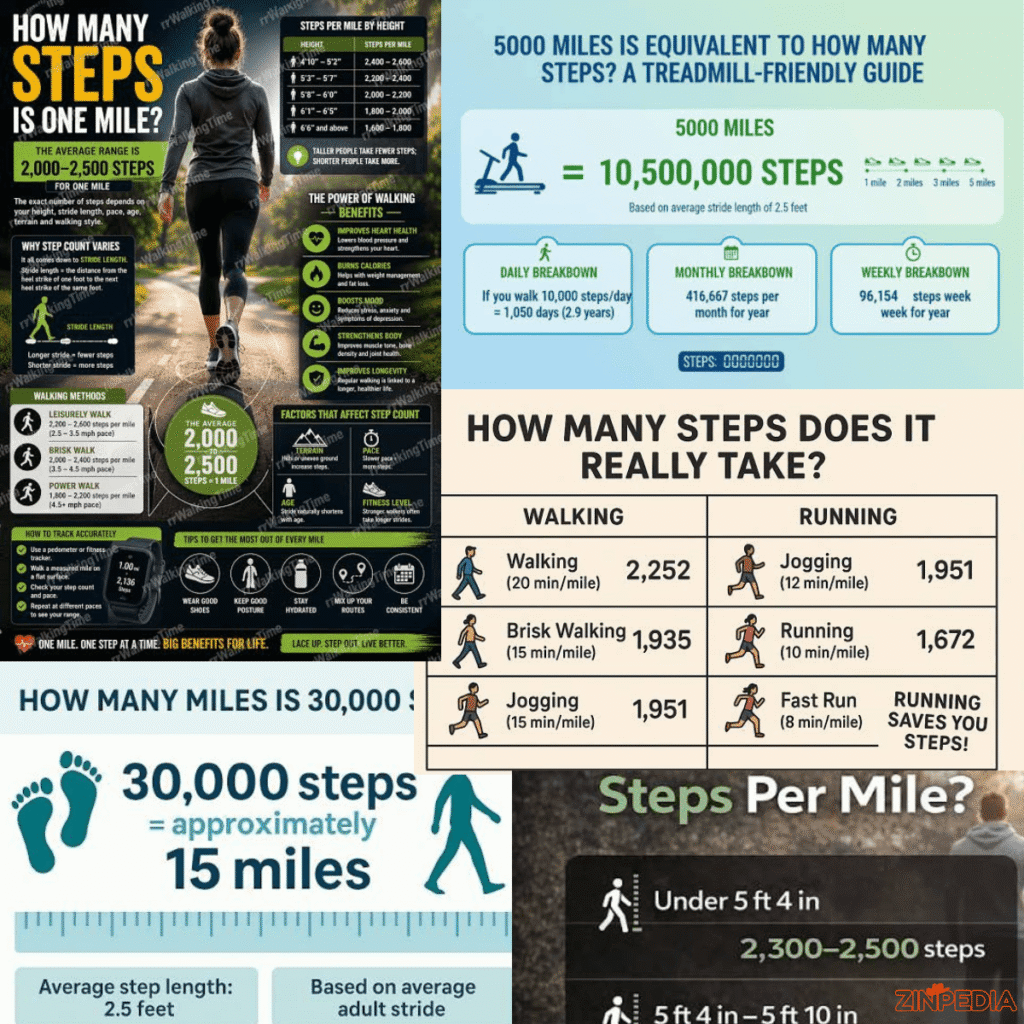
For most adults, one mile is roughly 2,000 to 2,500 steps.
However, there is no single exact number for everyone. Your total steps per mile depend mainly on your height, stride length, walking speed, terrain, and whether you are walking or running.
A taller person with a longer stride may cover one mile in fewer steps, while someone with a shorter stride may need considerably more.
In this guide, you will learn the average number of steps in a mile, how height and pace affect your step count, how to calculate your own steps per mile, and how many miles common daily step goals may represent.
How Many Steps Are in a Mile?
A good general estimate is:
1 mile = about 2,000 to 2,500 walking steps
For many adults, a useful middle estimate is around:
2,100 to 2,200 steps per mile
But your actual number can be lower or higher.
For example:
- A person with a long stride may take around 1,900 to 2,100 steps per mile.
- A person with an average stride may take around 2,100 to 2,300 steps.
- Someone with a shorter stride may take 2,400 steps or more.
This variation is normal because a mile measures distance, while steps depend on the length of each step you take.
Quick steps-to-miles estimate
| Distance | Approximate Steps |
|---|---|
| 0.25 mile | 500–625 steps |
| 0.5 mile | 1,000–1,250 steps |
| 1 mile | 2,000–2,500 steps |
| 2 miles | 4,000–5,000 steps |
| 3 miles | 6,000–7,500 steps |
| 4 miles | 8,000–10,000 steps |
| 5 miles | 10,000–12,500 steps |
These numbers are estimates rather than exact measurements.
Why the Number of Steps in a Mile Is Different for Everyone
People often expect one mile to equal a fixed number of steps, but that is not how step counting works.
A mile is always the same distance, but people move differently.
Several factors influence your steps per mile.
Height
Height usually has a strong relationship with stride length.
Taller people often have longer legs and cover more distance with each step. As a result, they generally take fewer steps to complete a mile.
Shorter people usually have shorter strides and may need more steps to travel the same distance.
Stride length
Stride length is one of the most important factors.
If every step covers more distance, you need fewer steps to reach one mile.
If your steps are shorter, you need more of them.
For example, imagine two walkers:
- Walker A has a longer stride and takes 2,000 steps per mile.
- Walker B has a shorter stride and takes 2,400 steps per mile.
Both travel exactly one mile, but Walker B needs 400 additional steps.
Walking speed
Walking faster can change your stride.
Many people naturally increase their stride length when walking briskly. This may reduce the number of steps needed to complete a mile.
However, people move differently, so faster walking does not always produce the same change in step count.
Terrain
Walking uphill, downhill, on sand, through grass, or over uneven ground can affect your natural stride.
You may take shorter steps on difficult terrain, increasing your total step count.
Walking versus running
Running generally involves a longer stride than normal walking.
Because each running stride can cover more ground, runners often take fewer steps per mile than walkers.
How Many Steps in a Mile by Height?
Height can provide a useful estimate of how many steps you may take per mile.
The following table gives general estimates for adults walking at a comfortable pace.
| Height | Estimated Steps Per Mile |
|---|---|
| 5’0″ | 2,400–2,500 |
| 5’2″ | 2,300–2,450 |
| 5’4″ | 2,250–2,400 |
| 5’6″ | 2,150–2,350 |
| 5’8″ | 2,100–2,300 |
| 5’10” | 2,000–2,200 |
| 6’0″ | 1,950–2,150 |
| 6’2″ | 1,900–2,100 |
| 6’4″ | 1,850–2,050 |
These figures should be treated as approximations.
Two people of the same height can still have different step counts because of differences in leg length, pace, fitness level, age, walking style, and stride.
That is why measuring your own step count is more accurate than relying only on height.
How to Calculate Your Own Steps Per Mile
If you want a more accurate answer than a general estimate, you can calculate your personal steps per mile.
There are several easy ways to do it.
Method 1: Walk a measured mile
This is the simplest method.
Find a route that is exactly one mile long. You can use:
- A running track
- A GPS walking app
- A mapped walking trail
- A smartwatch
- A treadmill
Reset your step counter before starting.
Walk exactly one mile at your normal pace and record your steps at the end.
For example:
If your device shows 2,180 steps, then your approximate personal average is:
1 mile = 2,180 steps
Try repeating the test several times and calculate the average for better accuracy.
Method 2: Measure your step length
You can also estimate your steps per mile using step length.
One mile contains:
5,280 feet
If your average step length is 2.5 feet:
5,280 ÷ 2.5 = 2,112 steps
So you would take approximately:
2,112 steps per mile
The formula is:
Steps per mile = 5,280 ÷ step length in feet
If your step length is measured in inches, remember:
1 foot = 12 inches
For example, if your average step length is 30 inches:
30 inches = 2.5 feet
Then:
5,280 ÷ 2.5 = 2,112 steps
Method 3: Use your fitness tracker
Modern smartwatches and fitness trackers often estimate both distance and steps.
Check your statistics after several one-mile walks.
If your step totals consistently fall around 2,150 to 2,200 steps per mile, you have a useful personal estimate.
How Many Steps Are in 2, 3, 4, and 5 Miles?
Once you know your approximate steps per mile, converting larger distances becomes easy.
Using a general estimate of 2,000 to 2,500 steps per mile, you get:
2 miles
2 miles = approximately 4,000 to 5,000 steps
3 miles
3 miles = approximately 6,000 to 7,500 steps
4 miles
4 miles = approximately 8,000 to 10,000 steps
5 miles
5 miles = approximately 10,000 to 12,500 steps
Here is a larger reference chart:
| Miles | Approximate Steps |
|---|---|
| 1 mile | 2,000–2,500 |
| 2 miles | 4,000–5,000 |
| 3 miles | 6,000–7,500 |
| 4 miles | 8,000–10,000 |
| 5 miles | 10,000–12,500 |
| 6 miles | 12,000–15,000 |
| 7 miles | 14,000–17,500 |
| 8 miles | 16,000–20,000 |
| 9 miles | 18,000–22,500 |
| 10 miles | 20,000–25,000 |
Again, your personal numbers may differ.
How Many Miles Are 5,000, 10,000, and 20,000 Steps?
Many people track steps rather than miles.
If that sounds familiar, you may want to know how far your daily step total represents.
Using an average of approximately 2,000 to 2,500 steps per mile:
5,000 steps
5,000 steps is roughly:
2 to 2.5 miles
For someone who averages 2,200 steps per mile:
5,000 ÷ 2,200 = about 2.27 miles
10,000 steps
10,000 steps is roughly:
4 to 5 miles
Using 2,200 steps per mile:
10,000 ÷ 2,200 = about 4.55 miles
So for many people, 10,000 steps is close to four and a half miles.
15,000 steps
15,000 steps is approximately:
6 to 7.5 miles
Using 2,200 steps per mile:
15,000 ÷ 2,200 = about 6.82 miles
20,000 steps
20,000 steps is roughly:
8 to 10 miles
Using 2,200 steps per mile:
20,000 ÷ 2,200 = about 9.1 miles
Here is a quick comparison:
| Steps | Approximate Miles |
|---|---|
| 1,000 | 0.4–0.5 mile |
| 2,000 | 0.8–1 mile |
| 5,000 | 2–2.5 miles |
| 7,500 | 3–3.75 miles |
| 10,000 | 4–5 miles |
| 15,000 | 6–7.5 miles |
| 20,000 | 8–10 miles |
These estimates become more useful once you know your own average step length.
Walking vs Running: Which Takes More Steps Per Mile?
Walking and running usually produce different step counts.
When you run, your stride often becomes longer.
That means you may cover more distance with each step and complete a mile using fewer total steps.
A typical walking mile might require:
About 2,000 to 2,500 steps
A running mile may require approximately:
1,400 to 2,000 steps
However, running step counts vary significantly.
A shorter runner with a quick cadence may take more steps than a taller runner with a longer stride.
Speed matters too.
Someone jogging slowly may have a different stride pattern from someone running at a fast pace.
Therefore, there is no universal number of running steps in a mile.
If accurate tracking matters to you, measuring your personal step count with a fitness tracker is the better approach.
How Long Does It Take to Walk One Mile?
Step count and walking time are closely related, so people often ask how long a mile takes to walk.
For many adults, a mile can take approximately:
15 to 22 minutes
A brisk walker may complete a mile in around 15 to 18 minutes.
Someone walking at a comfortable or slower pace might need 20 minutes or more.
For example:
- 15-minute mile = brisk walking
- 18-minute mile = moderate walking
- 20-minute mile = comfortable walking
- 22+ minute mile = slower walking
Age, fitness, hills, weather, traffic, and terrain can all affect walking time.
The important point is that walking speed does not change the length of a mile. It only changes how quickly you complete it and possibly how many steps you take.
Are Fitness Trackers Accurate for Counting Steps?
Smartwatches, phones, and fitness trackers are useful tools, but they do not always record exactly the same number of steps.
They typically rely on motion sensors and algorithms to identify your movements.
Step counts can sometimes be affected by:
- Where the device is worn
- Arm movement
- Walking speed
- Device sensitivity
- Pushing a stroller or cart
- Carrying something in your hands
- Walking on unusual terrain
- Device calibration
A small difference in step count is usually not important for everyday fitness tracking.
If you want more consistent results, wear your tracker in the recommended position and use the same device over time.
Consistency can be more useful than comparing numbers from several different devices.
Does Stride Length Matter More Than Height?
Height is helpful for estimating steps, but stride length gives a more direct measurement.
Consider two people who are both 5 feet 8 inches tall.
One may naturally take longer steps, while the other may use shorter steps.
Even though they are the same height, their steps per mile can be different.
This is why measuring your personal stride or completing a measured one-mile walk provides a better estimate.
Simple step-length test
To estimate your step length:
- Mark a starting point.
- Walk 10 normal steps.
- Measure the total distance.
- Divide the distance by 10.
For example:
If 10 steps cover 25 feet:
25 ÷ 10 = 2.5 feet per step
Then:
5,280 ÷ 2.5 = 2,112 steps per mile
This gives you a useful personal estimate without needing advanced equipment.
Tips for More Accurate Step Tracking
If you use daily step goals, a few simple habits can make your tracking more reliable.
- Use the same fitness device consistently.
- Make sure your height and other profile details are entered correctly.
- Wear your tracker where the manufacturer recommends.
- Test your step count over a known distance.
- Compare several walks rather than relying on one measurement.
- Remember that terrain and pace can change your stride.
- Focus on long-term trends rather than small daily differences.
You do not need perfectly precise numbers for everyday walking goals.
A consistent measurement system is often enough to track progress.
Frequently Asked Questions
How many steps are in 1 mile?
Most adults take approximately 2,000 to 2,500 steps to walk one mile. The exact number depends on height, stride length, pace, and walking style.
Is 2,000 steps equal to one mile?
For some people, yes.
However, 2,000 steps may be slightly less than a mile for people with shorter strides. A typical mile can require anywhere around 2,000 to 2,500 walking steps.
How many miles is 10,000 steps?
For many adults, 10,000 steps is approximately 4 to 5 miles.
The exact distance depends on your step length.
How many steps are in half a mile?
Half a mile usually requires around:
1,000 to 1,250 steps
How many steps are in a quarter mile?
A quarter mile is approximately:
500 to 625 steps
How many steps are in 2 miles?
Two miles generally equal about:
4,000 to 5,000 steps
How many steps are in 3 miles?
Three miles are approximately:
6,000 to 7,500 steps
How many steps are in 5 miles?
Five miles are approximately:
10,000 to 12,500 steps
How many miles are 5,000 steps?
5,000 steps are usually around:
2 to 2.5 miles
How many miles are 20,000 steps?
20,000 steps are approximately:
8 to 10 miles
Do taller people take fewer steps per mile?
Generally, taller people have longer strides and therefore may take fewer steps per mile. However, stride length and walking style also matter.
Does walking faster reduce steps per mile?
It can. Some people naturally increase their stride length while walking faster, which may reduce the number of steps needed to complete a mile.
How can I find my exact steps per mile?
Walk a measured one-mile route while using a reliable step counter. The number shown at the end is your approximate personal steps per mile. Repeat the test a few times and use the average.
Conclusion
So, how many steps are in a mile?
For most adults, the answer is approximately:
2,000 to 2,500 steps per mile
However, there is no exact number that applies to everyone.
Your height, stride length, walking speed, terrain, and movement style all influence how many steps you need to cover one mile.
As a quick reference:
- ¼ mile = about 500–625 steps
- ½ mile = about 1,000–1,250 steps
- 1 mile = about 2,000–2,500 steps
- 2 miles = about 4,000–5,000 steps
- 5 miles = about 10,000–12,500 steps
If you want the most accurate number, walk exactly one mile while wearing your usual fitness tracker and record your steps.
That personal measurement will always be more useful than a general estimate because it reflects the way you actually walk.
Explore More Helpful Articles– Visit Now