

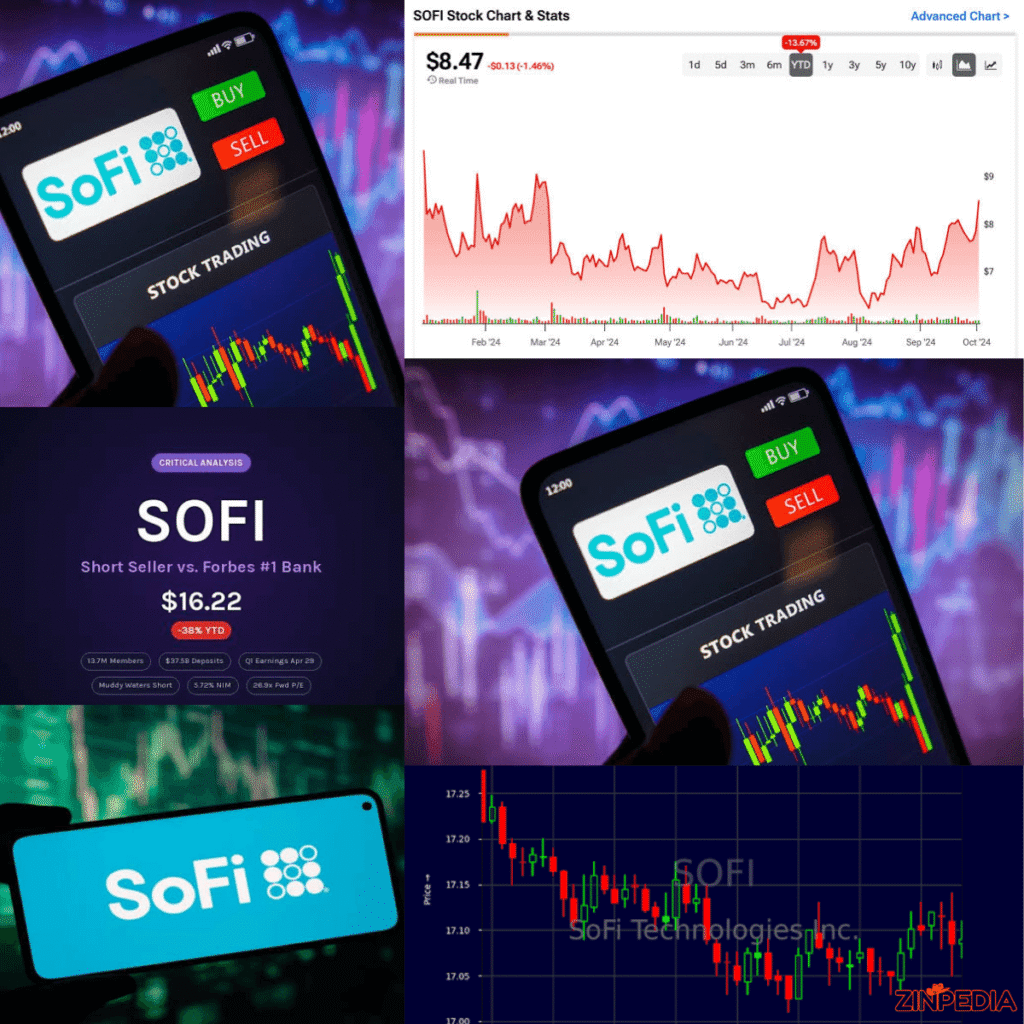
SoFi Technologies has grown from a student-loan refinancing company into a broad digital financial-services business. Today, its platform includes lending, banking, investing, credit cards and financial technology infrastructure.
That wider business model has made SoFi stock, traded on Nasdaq under the ticker SOFI, popular among growth investors. Supporters see a fast-growing digital bank with rising membership, expanding revenue and improving profitability. Critics argue that the stock already reflects a large amount of future growth and remains exposed to credit conditions, interest rates, regulation and competition.
As of July 24, 2026, SOFI shares were trading near $16.59, giving the company a market value of approximately $22.9 billion. Its trailing price-to-earnings ratio was around 36.9, based on the latest available market data.
The question for investors is therefore not simply whether SoFi is growing. The more important question is whether the company can grow fast enough—and profitably enough—to justify its valuation.
This article examines the latest SoFi stock news, financial results, growth drivers, risks, and a scenario-based price prediction for 2026.
Important: This article is for general information and education. It is not personalized financial advice, and no stock-price forecast is guaranteed.
What Is SoFi Technologies and How Does It Make Money?
SoFi Technologies is a digital financial-services company and bank holding company. Through SoFi Bank and its broader technology platform, it offers products that help customers borrow, save, spend, and invest money.
Its operations are divided into three main segments:
Lending
The Lending segment includes:
- Personal loans
- Student-loan refinancing
- Home loans
- Loan servicing
- Loans originated for third-party partners
Lending has historically generated a large share of SoFi’s revenue. The company earns interest on loans held on its balance sheet and may also earn fees by originating or selling loans.
This segment can perform well when loan demand is strong, and borrowers continue making payments. However, it also exposes SoFi to credit losses, economic slowdowns, and changes in interest rates.
Financial Services
The Financial Services segment includes products such as:
- SoFi Checking and Savings
- SoFi Invest
- Credit cards
- SoFi Relay
- Insurance referrals
- Other member-focused financial products
This part of the company is important because it allows SoFi to build longer relationships with members.
A customer may initially join SoFi for a personal loan but later open a savings account, use a credit card, or start investing through the platform. SoFi calls this cross-selling strategy its Financial Services Productivity Loop.
The company reported that Financial Services products reached approximately 19.3 million in the first quarter of 2026. SoFi Money and Relay each reached about 7.3 million products, while SoFi Invest reached approximately 3.7 million.
Technology Platform
SoFi’s Technology Platform provides financial infrastructure to other businesses. It includes technology associated with Galileo and other acquired platforms.
This business is intended to help banks, fintech companies, and other clients operate services such as:
- Payment processing
- Digital account management
- Card services
- Core banking technology
- Financial application infrastructure
The Technology Platform gives SoFi an opportunity to earn business-to-business revenue rather than depending entirely on consumer loans and banking products.
However, this segment has recently been the weakest part of the company. First-quarter 2026 Technology Platform revenue fell 27% year over year to approximately $75.1 million, partly because a large client completed its transition away from the platform before the end of 2025. Enabled accounts were down 16% year over year, although they increased by four million from the previous quarter.
Latest SoFi Stock News Investors Should Know
Several recent developments are shaping the investment case for SoFi Technologies stock.
Record first-quarter results did not satisfy every investor.
SoFi reported strong operating results for the first quarter of 2026.
Adjusted net revenue reached approximately $1.09 billion, increasing 41% from the same period in 2025. Adjusted EBITDA rose 62% to nearly $340 million, while GAAP net income reached approximately $166.7 million. Diluted earnings per share doubled from $0.06 to $0.12.
Despite those records, SOFI shares fell sharply after the earnings announcement. Reuters reported that the stock dropped approximately 12% because management maintained its previous full-year outlook instead of raising it. Some investors had expected stronger guidance following the first-quarter performance.
This reaction illustrates an important feature of growth stocks: strong results may not lift the share price when market expectations are already higher.
Q2 2026 earnings are the next major catalyst.
SoFi has scheduled its second-quarter 2026 earnings release for July 29, 2026, before the US market opens. The company plans to discuss the results during a conference call at 8:00 a.m. Eastern Time.
Investors will be watching for:
- Member and product growth
- Personal-loan performance
- Credit-loss trends
- Deposit growth
- Loan Platform Business volume
- Technology Platform stabilization
- Updated full-year guidance
- Progress in newer business lines
Because the earnings report is scheduled only a few days after this article’s publication date, the latest figures should be reviewed and updated after July 29.
SoFi expanded its Loan Platform Business.
In March 2026, SoFi announced three agreements representing more than $3.6 billion in expected personal-loan funding.
The deals encompassed a global bank, an asset manager, and a financial-services and insurance group. The company also stated that its Loan Platform Business is able to make fee income from originating loans for partners and keeping the servicing rights.
This business matters because it may allow SoFi to serve additional borrowers without keeping every loan on its own balance sheet.
A more capital-light model could help the company generate fees, increase lending volume and reduce the amount of capital required to support growth. However, results will still depend on partner demand, borrower quality and successful execution.
SoFi is expanding business banking and digital-asset services.
In April 2026, SoFi introduced a business-banking platform designed to combine regulated deposit accounts, real-time payments, application programming interfaces and support for digital assets.
The company presented the service as a way for businesses to manage traditional money and selected digital assets through one regulated platform.
This initiative could create a new source of deposits, payment activity and fee revenue. It also carries execution and regulatory risk because institutional banking and digital assets are highly competitive and closely regulated markets.
SoFi continues adding investment products.
The company’s July 2026 press release list also included the expansion of its exchange-traded fund lineup with the Social 50 Income ETF. Product additions may strengthen customer engagement, although a new investment product is unlikely to transform earnings by itself.
SoFi’s Financial Performance: Is the Business Improving?
The clearest positive development is that SoFi is no longer valued only on the possibility of future profitability. It has started producing consistent GAAP profits.
Revenue growth remains strong.
First-quarter 2026 GAAP net revenue reached approximately $1.10 billion, up 43% from $771.8 million in the comparable 2025 quarter.
Adjusted net revenue increased 41% to approximately $1.09 billion. Net interest income rose 39% to $693 million, while total fee-based revenue increased 23% to approximately $386.8 million.
These figures show that growth came from both interest income and fee-generating activities.
Membership continues expanding
SoFi added approximately 1.06 million members during the first quarter, bringing total membership to 14.7 million. That represented growth of 35% from the previous year.
Total products increased 39% to nearly 22.2 million, while the company reported a 43% cross-buy rate.
Membership growth is useful, but investors should look beyond the headline number. Long-term value depends on whether new members become active, profitable customers who use multiple products.
Profitability has improved
SoFi reported its tenth consecutive profitable quarter under generally accepted accounting principles.
First-quarter GAAP net income was approximately $166.7 million, compared with $71.1 million one year earlier. Adjusted EBITDA margin increased to 31%, and diluted earnings per share reached $0.12.
Improving margins are important because they suggest that revenue is growing faster than some of the company’s central expenses.
Deposits provide lower-cost funding.
SoFi reported approximately $40.2 billion in deposits at the end of the first quarter, an increase of $2.7 billion during the quarter.
Average deposits represented more than 90% of average total liabilities. The average deposit rate was 1.55 percentage points lower than the rate paid on warehouse facilities, according to the company. SoFi estimated that this difference represented approximately $621.8 million in annualized interest savings.
Lower-cost deposits can improve the economics of lending, but SoFi must still offer competitive rates and maintain customers’ confidence.
Management maintained its 2026 outlook.
For full-year 2026, management expects:
Metric Management outlook
Member growth At least 30%
Adjusted net revenue About $4.655 billion
Adjusted revenue growth About 30%
Adjusted EBITDA About $1.6 billion
Adjusted EBITDA margin About 34%
Adjusted net income About $825 million
Adjusted EPS About $0.60
These are company forecasts rather than guaranteed results. They are also mainly non-GAAP measures, which exclude or adjust certain items.

The Bull Case for SoFi Stock
The bullish argument rests on the idea that SoFi can develop into a large, diversified digital financial institution rather than remaining mainly an online lender.
Strong member growth creates cross-selling opportunities.
Adding customers at a rate above 30% gives SoFi a larger audience for checking accounts, loans, investing, credit cards, and other services.
Cross-selling can reduce the average cost of acquiring each additional product because the customer is already inside the SoFi ecosystem.
The strategy becomes especially powerful when members use SoFi as their primary financial account rather than only visiting the platform for one loan.
Profit margins may continue improving.
Revenue growth does not automatically create shareholder value. Expenses must grow more slowly than revenue.
SoFi’s first-quarter adjusted EBITDA grew 62%, compared with adjusted revenue growth of 41%. That operating leverage is one reason investors may assign the stock a higher valuation than slower-growing traditional banks.
The company’s full-year target of a 34% adjusted EBITDA margin suggests management expects further operating efficiency.
The Loan Platform Business could make growth less capital-intensive.
Originating loans for outside investors can produce fee income without requiring SoFi to keep every loan.
If the company continues securing large funding agreements, it may be able to increase originations while managing balance-sheet exposure more carefully.
The Loan Platform Business provided $140.8 million of adjusted net revenue in the first quarter. The bulk of that was associated with roughly $3 billion in personal loans originated on behalf of third parties and borrower referrals.
A broader product range may support a premium valuation.
SoFi combines consumer banking, lending, investing, and financial technology. Investors may eventually value it as more than a traditional bank when the company proves that these businesses can reinforce one another.
A successful Technology Platform recovery would strengthen that argument because it would add recurring business-to-business revenue to the consumer ecosystem.
Major Risks That Could Push SOFI Stock Lower
SoFi stock is not a low-risk investment. Its performance can change quickly when earnings, guidance, or economic conditions disappoint the market.
The valuation requires continued growth.
At approximately $16.59 per share, SoFi’s trailing price-to-earnings ratio was close to 36.9. Using management’s adjusted 2026 EPS target of $0.60, the stock traded at roughly 27.6 times that projected adjusted figure.
That valuation is not extreme for a rapidly growing technology-oriented company, but it is considerably more demanding than the valuation normally assigned to many mature banks.
A lower growth rate, weaker guidance or disappointing margins could cause the market to apply a smaller earnings multiple.
Consumer credit could weaken.
SoFi holds and originates consumer loans. Higher unemployment, financial stress or an economic slowdown could increase missed payments and credit losses.
The company lists loan performance, the ability to originate and sell loans, banking-sector conditions and wider economic developments among its material risks.
Personal loans can offer attractive yields, but they are unsecured. Investors should therefore monitor delinquency rates, charge-offs and management’s credit-loss expectations.
Technology Platform performance remains weak.
The 27% decline in Technology Platform revenue was a major negative in the first-quarter report.
If this segment does not stabilize, SoFi may remain more dependent on lending than its diversified financial-technology story suggests.
Investors should look for:
- Returning account growth
- New client wins
- Improved revenue retention
- Higher contribution margins
- Successful integration of platform products
Interest-rate movements can produce mixed effects.
Lower rates may increase demand for refinancing and home loans. However, they can also reduce yields on assets and pressure net interest income.
Higher rates can support asset yields but may weaken loan demand, increase customer stress and raise funding competition.
The final effect depends on the speed of rate changes, deposit pricing, credit quality and the composition of SoFi’s loan portfolio.
Regulation is a continuing risk.
SoFi operates as a bank holding company and offers products in heavily regulated financial markets.
Changes involving banking rules, consumer lending, capital requirements, data protection, digital assets or government loan programs could increase costs or limit certain activities.
The company’s SEC filing specifically identifies the evolving regulatory environment and compliance complexity as important uncertainties.
Share dilution can affect per-share value.
Investors should monitor stock-based compensation, convertible securities, and changes in diluted share count.
A company can grow total net income while producing slower earnings-per-share growth when the number of shares increases. SoFi’s diluted weighted-average share count was approximately 1.38 billion in the first quarter of 2026, compared with approximately 1.19 billion one year earlier.
SoFi Stock Price Prediction: Bear, Base and Bull Scenarios
No one can reliably predict an exact future stock price. A more useful approach is to build several scenarios based on earnings, growth, and valuation.
Management currently expects approximately $0.60 in adjusted EPS for 2026. The following model applies different price-to-earnings multiples to that estimate.
ScenarioAssumed multipleIllustrative price range What could cause it?
Bear case 18–22 times $10.80–$13.20 Slower growth, weaker credit, reduced guidance or valuation compression
Base case 26–32 times $15.60–$19.20 Guidance achieved, healthy member growth and stable credit performance
Bull case 36–42 times $21.60–$25.20 Guidance raised, stronger margins, platform recovery and faster fee growth
These ranges are valuation illustrations, not guaranteed price targets.
Bear case: $10.80 to $13.20
The bear case assumes that investors begin valuing SoFi more like a financial company than a high-growth technology business.
Possible triggers include:
- Credit losses rising faster than expected
- Member growth dropping sharply
- Full-year guidance being reduced
- Technology Platform revenue continuing to decline
- Weak deposit growth
- Increased share dilution
- A wider sell-off in growth stocks
At $12 per share, SOFI would trade at 20 times the company’s current adjusted EPS target.
Base case: $15.60 to $19.20
The base case assumes that SoFi broadly meets its 2026 guidance.
This scenario would likely require:
- Revenue growth remaining close to 30%
- Adjusted EPS approaching $0.60
- No major credit deterioration
- Continued deposit and member growth
- Stable Loan Platform Business demand
- Early signs of improvement in the Technology Platform
The current price of approximately $16.59 sits inside this base-case range.
Bull case: $21.60 to $25.20
The bull case assumes that SoFi exceeds expectations and receives a stronger growth-stock valuation.
Potential catalysts include:
- Management raising its full-year outlook
- Better-than-expected Q2 and Q3 earnings
- Strong fee-based revenue
- Lower credit losses
- Technology Platform growth returning
- Rapid adoption of new business-banking products
- Continued margin expansion
A price above $25 would require either earnings above the current target, a high valuation multiple, or both.
What is the most reasonable 2026 range?
Based on management’s existing adjusted EPS target and the company’s current growth rate, an illustrative base range of $15.60 to $19.20 appears more balanced than an extremely bullish or bearish target.
However, the July 29 earnings report could quickly change that assessment. A guidance increase may support a higher range, while weaker credit trends or unchanged expectations could pressure the stock.
SoFi Stock FAQs and Final Verdict
Is SoFi stock a buy now?
SoFi may suit investors who accept substantial volatility and believe the company can maintain strong revenue and earnings growth.
It may be less suitable for investors who need predictable dividends, low valuation risk, or stable short-term returns.
A sensible decision should consider:
- Personal risk tolerance
- Investment time horizon
- Portfolio diversification
- Current valuation
- Credit-market conditions
- The latest earnings report
Does SoFi pay a dividend?
SoFi is generally viewed as a growth investment rather than an income stock. Investors should check the company’s current dividend information before buying because capital-return policies can change.
Why is SOFI stock so volatile?
The stock reacts strongly to:
- Earnings results
- Revenue and EPS guidance
- Interest-rate expectations
- Consumer-credit data
- Member growth
- Analyst valuation changes
- Fintech-sector sentiment
- Broader growth-stock performance
Its share price may fall after good results when the market expected even better numbers, as happened following the first-quarter 2026 report.
What is the biggest opportunity for SoFi?
The largest opportunity is turning millions of members into long-term users of several financial products.
If SoFi can combine banking, lending, investing, payments and technology infrastructure while controlling customer-acquisition costs, it may build a valuable financial ecosystem.
What is the biggest risk?
The central risk is that SoFi may not deliver enough profitable growth to justify its valuation.
A combination of weaker credit, slower membership growth, declining Technology Platform revenue, and valuation compression could produce a significant share-price decline.
What should investors watch in the next earnings report?
The most important items are:
- Adjusted net revenue growth
- GAAP and adjusted EPS
- Personal-loan charge-offs
- Member additions
- Deposit balances
- Loan Platform Business volume
- Technology Platform revenue
- Updated 2026 guidance
Final verdict
SoFi Technologies entered 2026 with strong momentum. The company delivered record first-quarter revenue, added more than one million members, and reported its tenth consecutive profitable quarter. Its deposit-funded banking model, growing Financial Services segment, and expanding Loan Platform Business support the long-term bullish argument.
Nevertheless, SOFI stock is not automatically cheap because the business is performing well. At approximately $16.59, the valuation still assumes that management will achieve substantial revenue growth, expand margins, and maintain healthy consumer credit.
The balanced view is that SoFi is becoming a stronger company, but its stock remains sensitive to expectations. Investors should focus less on daily price movements and more on revenue quality, earnings per share, credit performance, share dilution, and progress in the Technology Platform.
For 2026, the scenario model suggests:
- Bear case: $10.80–$13.20
- Base case: $15.60–$19.20
- Bull case: $21.60–$25.20
The next important update is SoFi’s Q2 earnings release on July 29, 2026. Any publication using this article should review and update the financial figures after that report.
Explore More Helpful Articles– Visit Now