

Tiger Global Management is one of the best-known investment firms associated with technology, internet, software, consumer, and financial-services companies. Its portfolio spans public stocks, private companies, long-only funds, long/short strategies, and closed-end private-equity vehicles.
That broad structure is also why a simple question—“What is Tiger Global’s AUM in 2026?”—can produce several very different answers.
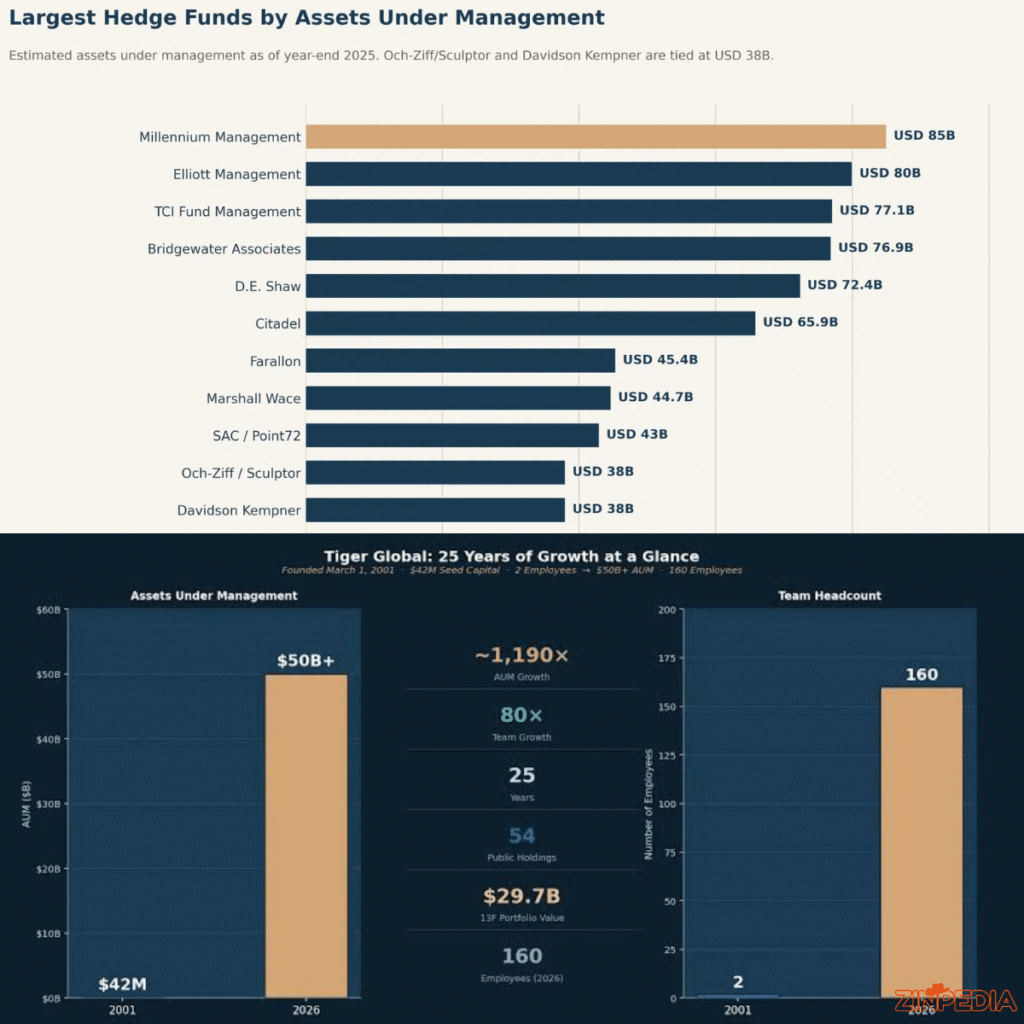
March 27, 2026: Tiger Global: $77.99 billion in discretionary regulatory assets under management reported to regulators. However, other industry reporting has described the firm as managing roughly $50 billion in net assets, while a publicly reported fund-level figure lists approximately $34.90 billion for Tiger Global Investments, LP, the flagship long/short vehicle.
These figures are not necessarily contradictory. They may represent different calculation methods, reporting dates, legal entities, leverage treatment, and master-feeder fund structures.
This guide describes Tiger Global 2026 AUM, the number in its long/short strategy, analysis of the latest public filings of Tiger Global, and an important reason why investors must not mistake regulatory AUM & quarter-to-date value as expressed by a quarterly 13F filing.
Important: This article is for general information and education. It is not investment advice, a recommendation to invest in a fund, or a guarantee of future performance.
1. What Is Tiger Global’s AUM in 2026?
The most recent regulatory figure available in July 2026 is approximately:
$77,993,959,953 in discretionary regulatory AUM
This number comes from Tiger Global Management’s March 27, 2026 Form ADV information. The filing also indicates that the firm manages assets on a discretionary basis, meaning it generally has authority to make investment decisions for the relevant funds without receiving separate approval for every trade.
Rounded to the nearest billion, Tiger Global’s reported regulatory AUM was therefore approximately:
[
$78\text{ billion}
]
However, $78 billion should not automatically be described as the amount of investor capital sitting inside Tiger Global’s flagship hedge fund.
Form ADV regulatory AUM can include assets managed across multiple investment vehicles. For private funds, the SEC’s calculation framework can include the current market or fair value of fund assets as well as certain uncalled capital commitments. Regulatory AUM is therefore a compliance measurement and may differ from net asset value or the amount described informally in media reports.
A separate analysis of the March 2026 filing estimated that Tiger Global managed approximately $54.7 billion in net assets on a discretionary basis as of January 1, 2026. Business Insider and Institutional Investor have also referred to Tiger Global as an approximately $50 billion manager during 2026.
A practical summary is:
| Tiger Global measurement | Reported figure | What it represents |
|---|---|---|
| Regulatory AUM | Approximately $77.99 billion | Form ADV regulatory calculation across the adviser |
| Estimated net assets | Approximately $54.7 billion | Net asset estimate derived from the 2026 filing |
| Media description | Approximately $50 billion | Rounded estimate of the current firm |
| Tiger Global Investments, LP | Approximately $34.90 billion | Reported assets of a major long/short fund entity |
| Q1 2026 13F portfolio | Approximately $22.85 billion | Disclosed long U.S.-listed securities only |
The correct number depends on what the reader is trying to measure.
The correct number depends on what the reader is trying to measure.
For firm-wide regulatory size, $77.99 billion is the clearest answer. For a rough estimate of net capital managed across the organisation, approximately $50 billion to $55 billion may be more meaningful. For the main long/short vehicle, the publicly reported fund-level figure is approximately $34.90 billion, with important master-feeder and gross-versus-net qualifications.
2. How Large Is Tiger Global’s Long/Short Fund?
Tiger Global’s flagship public-equity hedge-fund strategy is generally associated with Tiger Global Investments, often shortened to TGI.
A May 2026 review based on publicly available regulatory information listed the following figure:
Tiger Global Investments, LP AUM: $34,902,201,023
The same source listed 769 beneficial owners and a $1 million stated minimum for that legal entity.
It also identified other large Tiger Global entities, including:
| Fund entity | Reported assets |
| Tiger Global Investments, LP | $34.90 billion |
| Tiger Global Long Opportunities Master Fund, LP | $14.80 billion |
| Tiger Global, LP | $12.64 billion |
| Tiger Global, Ltd. | $7.60 billion |
| Tiger Global Long Opportunities, LP | $5.25 billion |
These numbers should not simply be added together to calculate the firm’s total AUM. Hedge funds frequently use master-feeder arrangements in which several feeder funds invest in one master portfolio. Adding every related vehicle may count some underlying assets more than once.
The $34.90 billion figure may also be closer to gross fund assets than to the amount investors would receive if all positions were closed and liabilities were paid. Long/short funds may hold cash received from short sales while also recording an obligation to return the borrowed securities. Depending on the regulatory calculation, these balance-sheet items can increase gross reported assets.
The safest publication wording is therefore:
Tiger Global Management reported approximately $77.99 billion in firm-wide regulatory AUM in March 2026. Public regulatory-data analysis lists approximately $34.90 billion for Tiger Global Investments, LP, its major long/short fund entity, although this figure should not be treated as a simple net-capital number.
That statement gives readers a useful answer without incorrectly suggesting that every AUM figure measures the same thing.
3. How Tiger Global’s Long/Short Strategy Works
A long/short equity fund can profit from two broad types of positions.
Long positions
A long position is an investment expected to increase in value.
For example, when a fund buys shares in a software company, it may believe that the company will:
- Increase revenue
- Gain customers
- Expand profit margins
- Strengthen its competitive position
- Benefit from a major technological trend
- Become more valuable over time
The potential gain comes from selling the shares later at a higher price, although the position can lose money when the share price falls.
Short positions
A short position is designed to benefit when a security declines.
In a traditional short sale, the fund borrows shares, sells them, and attempts to repurchase them later at a lower price. The borrowed shares must eventually be returned.
Short positions may be used to:
- Profit from companies expected to underperform
- Reduce broad market exposure
- Hedge a long portfolio
- Offset risks within an industry
- Express a relative-value view
Short selling carries substantial risk. A stock purchased as a long position can theoretically fall only to zero, but a shorted stock can rise far above its original price. The loss on an uncovered short position is therefore theoretically unlimited.
Tiger Global is a long-term oriented, research-driven investor in high-quality innovation companies at all stages of development. According to publicly available information about its investment process, the firm uses fundamental analysis, company research, financial models, valuation work, and continuing review of its portfolio when identifying long and short positions.
Tiger Global’s public-equity strategies include both long/short and long-focused funds. This distinction matters because the long-only portfolio receives full benefit when its selected stocks rise, while the long/short fund’s return is also affected by the performance of its short book.
In 2025, for example, Tiger Global’s long/short fund reportedly returned 7.9%, while its long-only fund gained 22.9%. That performance gap suggests the short portfolio reduced the long/short fund’s overall return during a year when many of its major long holdings performed well.
4. Why the 13F Portfolio Is Not Tiger Global’s Total AUM
Tiger Global’s Q1 2026 Form 13F reported:
- 54 disclosed holdings
- A total reported value of approximately $22.85 billion
- A reporting date of March 31, 2026
- A filing date of May 15, 2026
This $22.85 billion figure is sometimes incorrectly presented as Tiger Global’s total AUM. It is not.
A 13F is a quarterly report of certain types of securities owned by an institutional investment manager. This usually indicates long positions in securities that appear on the SEC’s official 13F list. It does not offer a comprehensive look at private investments, cash balances, many foreign-listed securities, liabilities, or the short-equity book of the fund.
The SEC specifically explains that short equity positions are not reported on Form 13F and are not subtracted from long positions in the same company. Written options are also excluded from the standard disclosure.
This creates three important limitations.
The filing shows longs, not net exposure.
Suppose a hypothetical fund owns $20 billion of long positions and holds $8 billion of short positions.
Its net equity exposure might be approximately:
[
$20\text{ billion}-$8\text{ billion}=$12\text{ billion}
]
A normal 13F analysis may show much of the $20 billion long portfolio but not the $8 billion short book. A reader cannot accurately calculate the fund’s net exposure from the 13F alone.
It excludes private-company holdings.
Tiger Global invests in public and private companies. Private investments in startups and growth-stage businesses generally do not appear as normal positions in the quarterly 13F table.
The information is delayed.
Institutional managers normally have up to 45 days after a quarter ends to file Form 13F. Tiger Global’s Q1 positions reflected March 31, 2026 holdings but were not filed until May 15. The portfolio may have changed during that period.
The 13F remains useful for identifying disclosed public-equity themes, but it should never be treated as a real-time picture of Tiger Global’s complete long/short portfolio.
5. Tiger Global’s Latest Public-Equity Holdings and Changes
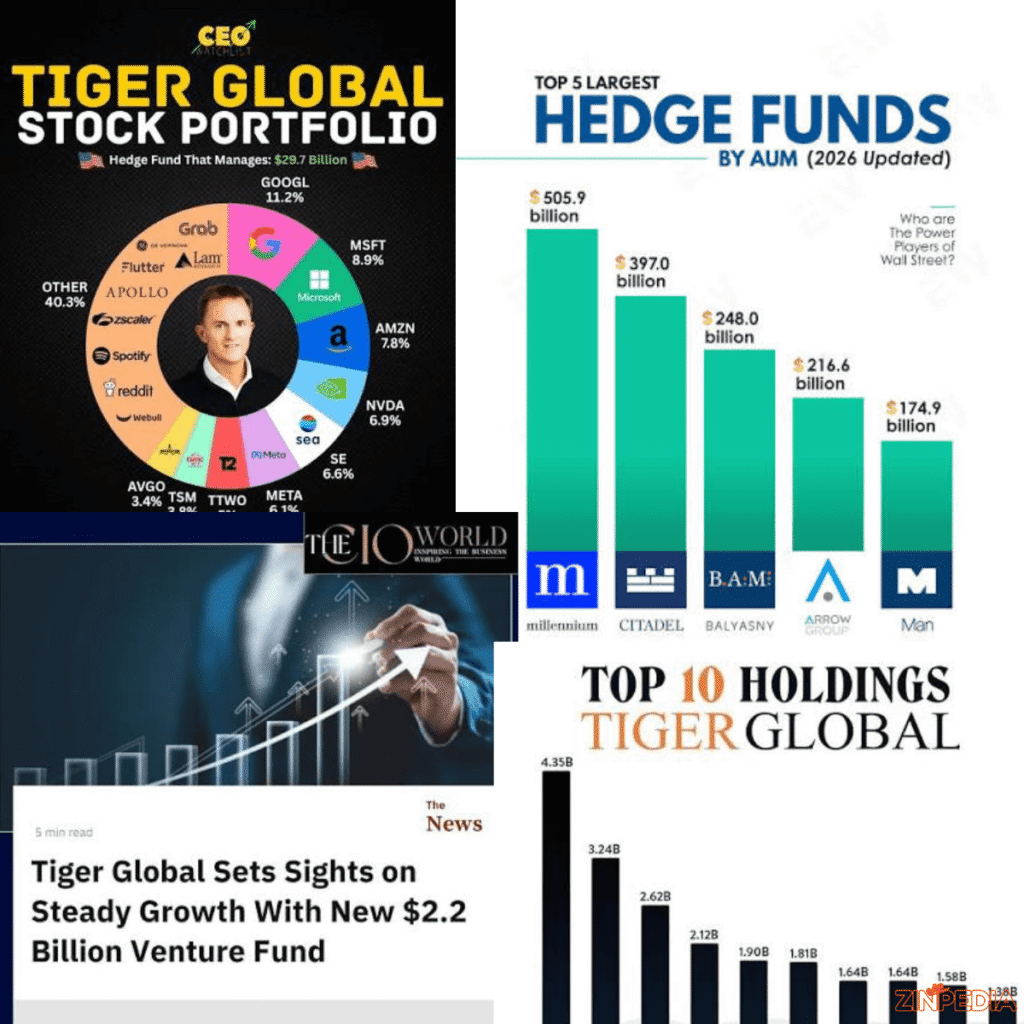
Tiger Global’s top disclosed Q1 2026 positions included Alphabet, Nvidia, Amazon, and Taiwan Semiconductor Manufacturing Company. The 54 positions with disclosed 13F value ended up totaling about $22.85 billion.
The reported value had fallen from approximately $29.71 billion at the end of Q4 2025. A decline in 13F value does not necessarily mean that investors withdrew the same amount. The total can change because of stock-price movements, sales, new purchases, transfers, or changes in which securities are reportable.
During the first quarter of 2026, Tiger Global disclosed new positions in companies including:
- Intel
- Robinhood Markets
- MercadoLibre
The MercadoLibre position was valued at approximately $233.4 million on March 31. Tiger Global’s new 1.6-million-share Intel position was worth around $72.3 million, while its 400,000-share Robinhood holding was valued at approximately $10.6 million.
The firm also increased several semiconductor-related investments. Its reported Taiwan Semiconductor position grew by approximately 49% during the quarter and was worth around $1.88 billion at quarter-end. Its Applied Materials stake increased by approximately 85% to a reported value of about $533 million.
Tiger Global exited its disclosed positions in Circle Internet Group and Workday, with the exception of cutting back exposure to Microsoft and Apollo Global Management.
These changes point toward continued interest in:
- Artificial-intelligence infrastructure
- Semiconductor manufacturing
- Digital financial services
- E-commerce
- Large technology platforms
However, investors cannot see Tiger Global’s corresponding short positions from its 13F. It is therefore impossible to determine from this filing alone whether the firm was broadly bullish, heavily hedged, or using shorts against specific industries.
6. Recent Performance and Key Risks
Tiger Global’s flagship long/short fund reportedly gained 7.9% in 2025. Its long-only fund gained 22.9%, while its crossover strategy returned 23.8%. The difference between the long/short and long-only results indicates that short positions—or other strategy differences—were a meaningful drag during the year.
The start of 2026 was volatile. Business Insider reported that the flagship hedge fund was down 3.4% through February. A later Institutional Investor report said the long/short fund lost 3.1% in March but still finished the first quarter up 2.5%, based on sources familiar with the results.
Business Insider subsequently reported that Tiger Global gained approximately 15% in April as technology stocks rebounded. These private-fund performance figures come from investor communications or sources familiar with the results rather than audited public-company earnings reports, so they should be presented with appropriate caution.
Concentration risk
Tiger Global’s disclosed portfolio remains strongly connected with technology, digital platforms, artificial intelligence, and semiconductor businesses.
A concentrated portfolio can produce strong returns when the manager’s largest ideas perform well. It can also suffer substantial losses when the same sector faces falling valuations, weaker earnings, regulatory pressure, or changing investor sentiment.
Short-position risk
Short positions can reduce losses when markets decline, but they can also hurt performance when heavily shorted stocks rise.
The 2025 difference between Tiger Global’s long/short and long-only funds shows how a short book can reduce returns even when the long portfolio performs strongly.
Valuation risk
Many technology and AI-related companies trade on expectations of rapid future growth.
When expectations become too optimistic, even a company with rising revenue can experience a falling share price if its earnings or guidance fail to satisfy investors.
Tiger Global and other major investors reduced several AI-related positions during Q4 2025 as markets became more concerned about valuations and the returns companies would generate from heavy AI spending.
Liquidity differences
Public stocks can normally be traded more quickly than private-company shares.
Tiger Global’s private investments may require years before an acquisition, initial public offering, secondary sale, or other liquidity event allows investors to realize value.
AUM interpretation risk
A large AUM figure does not prove that a strategy is performing well.
AUM may rise because markets increase, investors contribute capital, a fund uses leverage, or uncalled commitments are included. It may decline because of market losses, withdrawals, distributions, or fund closures.
Investors should examine AUM together with:
- Net asset value
- Gross and net exposure
- Investment returns
- Drawdowns
- Investor inflows and withdrawals
- Liquidity terms
- Fees
- Fund-level liabilities
7. Frequently Asked Questions About Tiger Global AUM
What is Tiger Global’s AUM in 2026?
Tiger Global’s March 27, 2026 regulatory information reported approximately $77.99 billion in discretionary regulatory assets under management. Other sources describe the company as an approximately $50 billion manager based on net or more commercially relevant asset measures.
How much does Tiger Global’s long/short fund manage?
Public regulatory-data analysis lists approximately $34.90 billion for Tiger Global Investments, LP. This should be treated as a reported fund-entity figure, not automatically as a clean measure of investor net asset value.
Why do some websites say $78 billion while others say $50 billion?
The estimates use different definitions.
The $78 billion figure is regulatory AUM calculated under Form ADV rules. The approximately $50 billion figure appears to refer to a rounded estimate of current net assets managed by the firm. Differences may also reflect reporting dates, private-fund commitments, liabilities, leverage, and related fund structures.
Is Tiger Global a hedge fund or venture-capital firm?
It is an investment-management firm operating several strategies.
Tiger Global manages public-equity long/short and long-focused funds as well as closed-end private-equity and venture-capital vehicles. The firm describes its approach as investing in innovative companies across different stages of their lifecycle.
Who founded Tiger Global?
Chase Coleman founded the firm in 2001. The firm began as Tiger Technology and developed into a major public- and private-market investment manager.
What is Tiger Global’s latest 13F portfolio value?
Tiger Global reported approximately $22.85 billion across 54 disclosed 13F positions as of March 31, 2026.
Is the 13F value the same as AUM?
No.
The 13F mainly covers certain long, reportable securities. It excludes the short-equity book and does not provide a complete picture of private investments, cash, liabilities, or total firm assets.
What were Tiger Global’s largest Q1 2026 holdings?
Its leading disclosed positions included Alphabet, Nvidia, Amazon, and Taiwan Semiconductor.
How did Tiger Global’s long/short fund perform in 2025?
The flagship long/short fund reportedly returned 7.9% in 2025. The firm’s long-only strategy gained 22.9%, and its crossover strategy gained 23.8%.
Can individual retail investors invest directly?
Tiger Global’s private funds are generally designed for accredited, qualified, sophisticated, or institutional investors. Publicly reported information lists substantial investment minimums, but eligibility and current access depend on each fund’s governing and offering documents.
Conclusion
The clearest answer to the question “What is Tiger Global’s AUM in 2026?” is:
- Firm-wide regulatory AUM: Approximately $77.99 billion
- Estimated net assets: Approximately $50 billion to $55 billion
- Reported Tiger Global Investments, LP assets: Approximately $34.90 billion
- Q1 2026 disclosed 13F portfolio: Approximately $22.85 billion
Each figure measures something different.
The $77.99 billion regulatory number provides the broadest official view of assets managed by the adviser. The approximately $34.90 billion fund-level figure helps explain the size of the flagship long/short structure, but it may include gross assets and should be interpreted carefully. The $22.85 billion 13F value shows only certain disclosed long public-equity positions and says nothing about the complete short book.
For readers researching Tiger Global’s long/short strategy, the most important lesson is not to rely on one headline AUM number. A useful analysis must separate regulatory AUM, net assets, fund-level gross assets, public long holdings, private investments, and net market exposure.
Tiger Global remains a large and influential technology-focused investment manager in 2026. However, understanding its real size and risk profile requires looking beyond the headline number and recognizing what each regulatory filing actually reveals.
Explore More Helpful Articles– Visit Now