
A flat tire can happen without warning.
You may notice the car pulling to one side, hear a repeated thumping sound, or see the tire-pressure warning light appear on the dashboard. In some cases, the tire may lose air slowly. In others, it may become flat within seconds.
Knowing how to change a tire can help you handle the situation calmly. However, installing a spare is only the first step. You must also decide whether the damaged tire can be repaired, whether it needs replacement, and which tire shop should inspect it.
This guide covers the complete process. You will learn how to replace a flat tire safely, when to search for tire repair near you, why tire rotation matters, and how services such as Discount Tire, Tire Rack, Mavis Tire, and independent local shops differ.
Important: Every vehicle is different. Always follow the instructions, jack locations, tire pressures, and wheel-torque specifications in your vehicle owner’s manual.
What to Do When You Notice a Flat Tire
Your priority is not changing the tire. It is getting yourself, your passengers, and the vehicle away from moving traffic.
Do not brake suddenly or turn the steering wheel sharply. Hold the wheel firmly, reduce your speed gradually, and move toward a safe stopping area.
Look for a place that is:
- Away from traffic
- Firm and level
- Clearly visible to other drivers
- Large enough to work around the vehicle
- Free from soft soil, mud, steep slopes, or road curves
Turn on the hazard lights and apply the parking brake after stopping. AAA recommends loosening the wheel nuts while the vehicle is still on the ground and using only the manufacturer-approved jack points.
Do Not Change the Tire in an Unsafe Location
Knowing how to change a tire does not mean you should attempt it in every situation.
Call roadside assistance when:
- The car is close to fast-moving traffic
- You cannot reach a flat, solid surface
- Visibility is poor
- The weather is dangerous
- You do not have the correct tools
- The spare tire is missing or flat
- The wheel nuts cannot be loosened
- You are not physically comfortable doing the work
- The vehicle was damaged in a collision
Never crawl beneath a vehicle supported only by its emergency jack.
A roadside jack is designed to lift the vehicle long enough to replace a wheel. It is not a safe support for working under the car.
Check Whether Your Vehicle Has a Spare
Do not assume that every car includes a spare tire.
Some newer vehicles use run-flat tires or provide a sealant and inflator kit instead. AAA recommends checking your vehicle’s equipment before an emergency and learning how any supplied inflator kit works.
Your tire-changing equipment may include:
- A temporary or full-size spare tire
- A vehicle jack
- A lug wrench
- A wheel-lock key
- An inflator and sealant kit
- Instructions in the owner’s manual
Useful additional items include gloves, a flashlight, a reflective warning triangle, a tire-pressure gauge, and wheel chocks.
Check the spare tire’s pressure during routine maintenance. A spare that has remained unused for years may not have enough air when you need it.
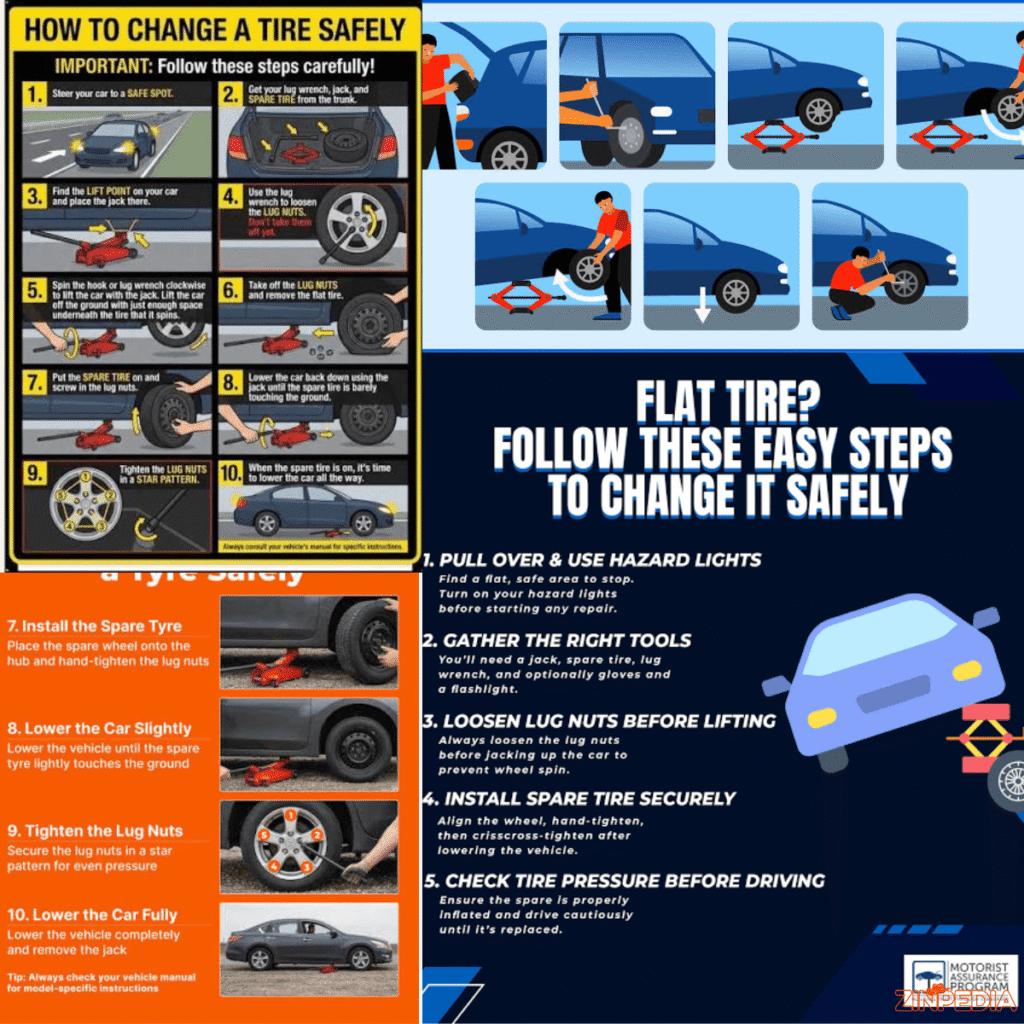
How to Change a Tire Step by Step
The following method applies to many passenger cars, but the exact procedure can vary. Read the relevant section of your owner’s manual before beginning.
Step 1: Secure the Vehicle
Turn off the engine, activate the hazard lights, and apply the parking brake.
Place the transmission in:
- Park for an automatic vehicle
- First gear or reverse for a manual vehicle
If wheel chocks are available, place them around the wheel diagonally opposite the flat tire.
For example, when changing the front-left tire, secure the rear-right wheel.
Step 2: Gather the Spare and Tools
Remove the spare tire, jack, lug wrench, and wheel-lock key from the vehicle.
Place the tools within easy reach but away from traffic.
Inspect the spare before lifting the car. Do not install it when it is visibly damaged, cracked, or completely deflated.
Step 3: Remove the Wheel Cover
Some wheels have a hubcap or decorative cover hiding the lug nuts.
Remove the cover according to the owner’s manual. It may pull away by hand or require the flat end of the lug wrench.
Place it somewhere safe so it does not roll away.
Step 4: Loosen the Lug Nuts
Fit the wrench securely over the first lug nut.
Turn it counterclockwise to loosen it. Do not remove it completely yet.
Loosen each nut about one-quarter to one-half turn while the tire remains on the ground. This prevents the wheel from spinning or the vehicle from becoming unstable while force is applied. AAA and Michelin both recommend loosening the nuts before lifting the vehicle.
A locking lug nut requires the matching wheel-lock key. Without it, you may need roadside assistance or a professional tire shop.
Step 5: Position the Jack Correctly
Find the recommended jacking point nearest the flat tire.
The correct point may be marked by a notch, reinforced metal section, or symbol beneath the vehicle. Never guess where the jack should go.
Placing it under plastic trim, thin bodywork, an oil pan, or an incorrect suspension part can damage the vehicle or cause it to fall.
Set the jack on a firm, level surface. A solid board may help prevent it from sinking when the ground is slightly soft, but changing a tire on unstable ground should still be avoided.
Step 6: Raise the Vehicle
Lift the vehicle slowly until the flat tire is several inches above the ground.
The inflated spare may need more clearance than the damaged tire.
Watch the jack while lifting. Stop immediately when it begins leaning, sinking, or moving out of position.
Keep passengers away from the vehicle and do not allow anyone to sit inside while it is raised.
Step 7: Remove the Lug Nuts and Flat Tire
Finish unscrewing the loosened lug nuts.
Place them inside the wheel cover, a container, or another clean location where they cannot become lost.
Grip the tire with both hands and then pull it towards you evenly. You will need to wiggle it free if it is stuck against the hub.
Do not hit the wheel aggressively while the vehicle is balanced on the emergency jack.
Step 8: Install the Spare Tire
Line up the holes in the spare wheel with the wheel studs.
Push the wheel inward until it sits flat against the hub.
Install each lug nut by hand. Turning them by hand first reduces the chance of cross-threading and damaging the studs.
Tighten them only until they are lightly seated.
Step 9: Lower the Vehicle Partly
Lower the car just enough to ensure the spare touches the ground and rotate it; if it’s not able to, don’t put full weight on it yet.
Tighten the lug nuts in a star or crossing pattern rather than moving around the wheel in a circle.
For a five-lug wheel, tighten:
- The first nut
- The nut opposite it
- The next opposite nut
- Continue crossing the center
This pattern helps seat the wheel evenly. Michelin advises tightening opposite wheel nuts and confirming the final setting with the vehicle manufacturer’s specified torque.

Step 10: Lower the Car Completely
Lower the vehicle fully and remove the jack.
Use the crossing pattern again to tighten the lug nuts. Do not jump on the wrench or use a pipe to create extreme force.
The correct tightness is a specific torque value, not simply “as tight as possible.” Check the owner’s manual and have the nuts verified with a torque wrench as soon as practical.
Step 11: Check the Spare and Store Your Equipment
Check the spare tire pressure with a gauge when possible.
Store the flat tire, jack, wrench, hubcap, and wheel-lock key securely. Do not leave loose tools inside the passenger area.
A compact spare is usually intended only for temporary use. Follow the speed and distance limits printed on the tire or listed in the owner’s manual. Michelin recommends checking a temporary spare’s operating limits and visiting a service facility promptly.
Can the Flat Tire Be Repaired, or Must It Be Replaced?
Installing a spare does not tell you whether the damaged tire is usable.
A qualified technician should remove the tire from the wheel and inspect both the outside and inside. Damage caused by driving while underinflated may not be visible from the exterior.
A Tire May Be Repairable When:
- The puncture is in the main tread area
- The hole is no larger than ¼ inch or 6 millimetres
- The tire was not driven for a long distance while flat
- The sidewall and shoulder are undamaged
- The internal structure remains intact
- The remaining tread is safe
- The damage does not overlap an older repair
The U.S. Tire Manufacturers Association states that a repairable puncture must be limited to the tread area and no larger than ¼ inch. It also recommends removing the tire for internal inspection and using both a plug or stem and an internal patch—not a simple external plug alone.
A Tire Usually Needs Replacement When:
- The sidewall has a cut or puncture
- A bubble or bulge appears on the sidewall
- The tread is separating
- Internal cords are visible
- The tire was driven while completely flat
- The puncture is too large
- The damage reaches the shoulder
- The wheel caused internal abrasion
- The tire has several overlapping repairs
- The tread has reached its wear indicators
Do not assume that adding air has solved the problem. Michelin advises having any punctured tire professionally inspected rather than repeatedly reinflating and driving on it.
How Much Tread Is Enough?
In the United States, tires should be replaced when the tread reaches 2/32 of an inch. Built-in treadwear bars become level with the tread when it reaches the replacement point. NHTSA recommends checking tread and pressure regularly, especially before longer trips.
The penny test provides a quick basic check:
- Place a U.S. penny into a tread groove.
- Turn Abraham Lincoln’s head downward.
- If the top of his head remains fully visible, the tread is too shallow.
Local legal requirements may differ outside the United States, so follow the rules in your country.
Why Tire Rotation Matters
The four tires on a vehicle do not always wear at the same rate.
Front tires may experience greater wear from steering, braking, and carrying more engine weight. Drive wheels also handle acceleration forces. As a result, one pair may wear much faster than the other.
Tire rotation moves the tires between positions to encourage more even wear.
Benefits of Regular Tire Rotation
A proper rotation can help:
- Reduce uneven tread wear
- Extend the usable life of the tire set
- Maintain more balanced handling
- Preserve traction between the front and rear axles
- Identify alignment or suspension problems earlier
- Support tire-warranty maintenance requirements
Follow the interval in your owner’s manual or tire warranty. Many tire providers recommend rotation roughly every 5,000 to 8,000 miles, but the correct schedule depends on the vehicle, tires, and driving conditions. Discount Tire’s published warranty guidance, for example, recommends rotations around every 5,000 to 6,000 miles.
Common Rotation Patterns
The correct tire-rotation pattern depends on the vehicle and tire design.
Common patterns include:
- Front-wheel drive: Front tires move straight back; rear tires cross to the front.
- Rear-wheel drive: Rear tires move straight forward; front tires cross to the rear.
- All-wheel drive: A crossing pattern may be used to keep wear balanced.
- Directional tires: Tires usually move from front to rear on the same side.
- Staggered wheels: Rotation may be limited when front and rear tire sizes differ.
Do not use a generic pattern without checking the owner’s manual.
Directional tires have arrows showing the required rolling direction. Some vehicles also use different wheel sizes on the front and rear, which can prevent normal rotation.
Rotation Is Not the Same as Alignment or Balancing
These services solve different problems:
Tire rotation changes the position of the tires.
Wheel balancing corrects uneven weight around the wheel-and-tire assembly. It may help reduce vibration.
Wheel alignment adjusts the angles at which the wheels meet the road. Poor alignment can cause pulling, an off-center steering wheel, and uneven tread wear.
A tire shop may recommend more than one service, but it should explain why each is needed.
Where to Buy Tires: Local Shops, Discount Tire, Tire Rack and Mavis
There is no single best place to buy tires for every driver.
The right option depends on price, availability, installation, warranty support, location, and the type of service your vehicle requires.
Independent Local Tire Shop
A good local tire shop may offer personal service and flexible repair options.
Possible advantages include:
- Direct access to experienced technicians
- Faster help with unusual wheel or tire problems
- Competitive installation prices
- Support for brands common in your area
- Easier follow-up with the same staff
Ask for a written, installed price rather than comparing only the advertised tire price.
The final amount may include:
- Mounting
- Balancing
- New valve stems
- TPMS service
- Disposal fees
- Sales tax
- Road-hazard protection
- Alignment
- Shop supplies
Discount Tire
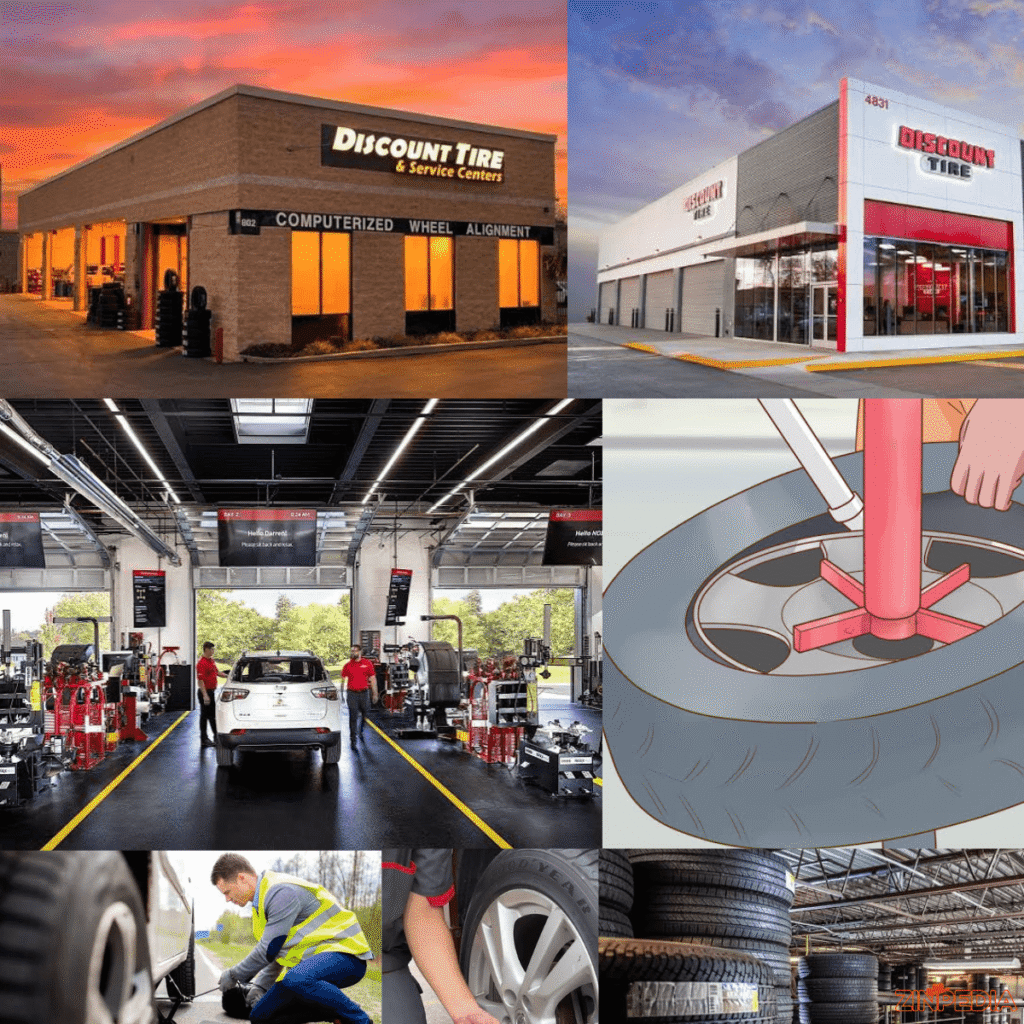
Discount Tire is a large U.S. tire and wheel retailer.
Its current official service pages list tire inspections, pressure checks, flat-tire repair, TPMS service, and rotation and balancing. The company states that tire rotation is available without charge and that balancing is included for tires purchased there; service terms can still vary by tire condition and location.
When searching for Discount Tire near me, check the individual store page for:
- Opening hours
- Appointment availability
- Current promotions
- Alignment availability
- Mobile installation
- Walk-in policies
- Tire stock for your vehicle
Do not choose a tire based only on the word “discount.” Compare the full installed price, warranty terms, tire age, performance rating, and future maintenance benefits.
Tire Rack
Tire Rack mainly helps drivers research and purchase tires online.
Its website provides test information, customer ratings, fitment tools, and a network of independent recommended installers. Buyers can arrange for an order to be shipped to a selected installer, their home, or another eligible location.
Tire Rack may suit shoppers who want to:
- Compare many tire models
- Read performance-test results
- Research before visiting a shop
- Order a less common size
- Send tires directly to an installer
- Arrange mobile installation where available
Remember that the tire price and installation price may come from different businesses. Confirm mounting, balancing, disposal, TPMS, and other charges with the selected installer.
Mavis Tire
Mavis offers tires and automotive services through its store network and related brands.
Its official website lists tire sales along with services such as rotation, brakes, alignments, oil changes, and general automotive repair. Specific services, prices, coupons, and appointment times can vary by location.
Mavis Tire may be convenient when you need both tire work and other vehicle maintenance during the same visit.
Before booking, check:
- Whether the advertised offer applies to your vehicle
- Whether balancing is included
- Whether the store has your tire size in stock
- Whether the price includes installation
- Whether an alignment inspection is separate
- What future rotation or warranty services are included
Which Option Is Best?
Provider typeBest forCheck before buying
Local tire shop Personal service and local support Reviews, repair method, warranty, and total price
Discount Tire Dedicated tire and wheel services Store availability and current service terms
Tire Rack Online research and broad product comparison Installer charges and delivery arrangements
Mavis Tire Tires plus wider automotive maintenance Location-specific pricing and included services.
Brand recognition can be helpful, but the quality of an individual location still matters.
How to Find a Reliable Tire Shop Near You
People often search phrases such as tire shop near me, tire shops near me, or tire repair near me during an urgent situation.
The closest result is not automatically the best result.
Search With Specific Details
A more focused search can produce better options.
Try searches such as:
- Tire repair near me open now
- Tire shop near me with roadside assistance
- Tire shop near me for run-flat tires
- Tire rotation near me
- Discount Tire near me
- Mavis Tire near me
- Tire shop near me with alignment
- Tire repair near me for a nail puncture
Include your city, neighbourhood, ZIP code, or postal code when the search engine does not identify your location correctly.
Check Recent Reviews Carefully
Do not look only at the average rating.
Read recent reviews that mention the exact service you need. A shop may be good at selling new tires but receive mixed feedback about waiting times, repairs, alignments, or warranty claims.
Useful review details include:
- Whether the quoted price matched the invoice
- Whether the staff explained the damage clearly
- Whether appointments started on time
- Whether wheel nuts were torqued correctly
- Whether the shop protected the wheels
- Whether customers received pressure and TPMS checks
- How the shop handled follow-up problems
A few negative reviews are normal. Look for repeated patterns and how the business responds.
Call Before Driving There
A short phone call can save time, especially when you are using a temporary spare.
Ask:
- Do you have my tire size in stock?
- Can you inspect a puncture today?
- What is the full installed price?
- Is balancing included?
- Is the puncture in a repairable area?
- Do you perform an internal patch-and-plug repair?
- Do you service run-flat tires?
- Is TPMS service available?
- How long is the current wait?
- Are future rotations included?
A trustworthy shop should be willing to explain its process without pressuring you into an immediate purchase.
Compare the Full Cost
A cheap advertised tire can become expensive after installation charges are added.
Request an estimate that includes:
- Tire price
- Mounting and balancing
- Valve or TPMS parts
- Disposal fees
- Taxes
- Alignment, if required
- Road-hazard coverage
- Future rotation and balancing
- Warranty conditions
Also confirm whether the quote is for one tire, two tires, or a complete set.
Know When Not to Drive to the Shop
Do not drive on a completely flat tire.
Driving even a short distance can damage the sidewall, wheel, and internal structure. It may turn a repairable puncture into a tire that must be replaced.
Use a safe spare, request mobile service, or arrange a tow.
Frequently Asked Questions and Final Advice
How long does it take to change a tire?
A prepared and experienced person may install a spare in around 15 to 30 minutes. It can take longer when the wheel is stuck, the lug nuts are tight, visibility is poor, or the tools are difficult to access.
Safety matters more than speed.
Can I change a tire without a jack?
No. A suitable jack is required to lift the vehicle safely.
Do not use bricks, unstable blocks, another vehicle, or makeshift lifting equipment.
Can I drive on a flat tire to reach a tire shop?
You should not drive on a conventional flat tire.
It can quickly suffer internal damage and may also damage the wheel. Run-flat tires have specific limits, so follow the tire and vehicle manufacturer’s instructions.
Can I repair a tire with a nail in it?
Possibly.
A small puncture in the central tread area may be repairable when the tire has not been driven flat and has no internal damage. A puncture in the shoulder or sidewall generally requires replacement. Proper inspection requires removing the tire from the wheel.
Is an external tire plug a permanent repair?
A plug inserted from the outside does not allow the technician to inspect the tire’s interior.
USTMA’s recommended procedure uses a rubber stem or plug to fill the injury and an internal patch to seal the inner liner after the tire has been removed and inspected.
How often should tire rotation be done?
Follow the schedule in the vehicle owner’s manual or tire warranty.
A common range is about every 5,000 to 8,000 miles, but some vehicles and tires require a different interval.
Should I replace one tire or all four?
It depends on tread difference, drivetrain, tire size, and vehicle requirements.
All-wheel-drive vehicles may require closely matched tread depths to protect the drivetrain and maintain stable handling. Ask the vehicle manufacturer or a qualified technician before replacing only one tire.
Is Discount Tire the same as a generic discount tire shop?
No.
Discount Tire is a specific company name. The phrase discount tire can also describe any tire sold at a reduced price.
Check the business name and website carefully when searching.
Does Tire Rack install tires?
Tire Rack sells tires online and can arrange shipment to recommended independent installers. Installation charges and services depend on the chosen installer. Mobile installation is available in certain areas.
Is Mavis Tire only a tire shop?
No. Mavis locations commonly provide tire services along with other vehicle maintenance and repair work. Exact services vary by location.
What should I keep in the car for a flat tire?
A useful emergency kit includes:
- Properly inflated spare
- Vehicle jack
- Correct lug wrench
- Wheel-lock key
- Flashlight
- Gloves
- Reflective warning triangle
- Tire-pressure gauge
- Portable inflator
- Roadside-assistance contact details
Final Thoughts
Learning how to change a tire gives you a useful emergency skill, but good judgment is just as important as knowing the steps.
Move away from traffic, use the correct jack point, loosen the lug nuts before lifting, install the spare carefully, and tighten the wheel using the correct pattern and manufacturer-specified torque.
After installing the spare, have the damaged tire inspected as soon as possible.
A proper tire shop can determine whether the puncture is safe to repair, check the remaining tread, confirm wheel-nut torque, and identify alignment or rotation needs.
Whether you choose an independent tire shop, Discount Tire, Tire Rack, Mavis Tire, or another provider, compare the complete service—not only the advertised price.
The best tire service is one that installs the correct product, follows safe repair standards, explains every charge, and helps keep your vehicle reliable after you leave the shop.
Explore More Helpful Articles– Visit Now