
Have you ever wondered how many seconds are in a day?
The exact answer is:
There are 86,400 seconds in a standard 24-hour day.
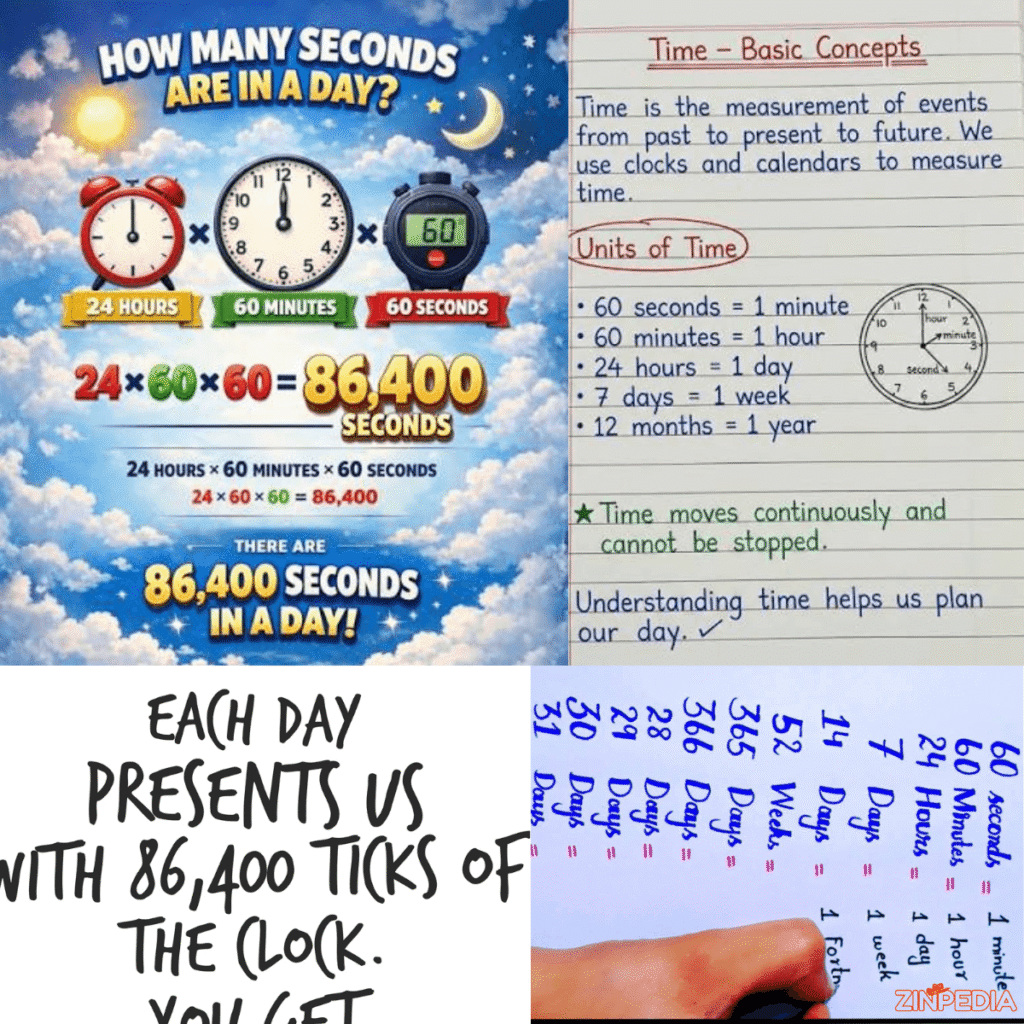
That number may look large, but the calculation is surprisingly simple. A day contains 24 hours, every hour has 60 minutes, and every minute has 60 seconds.
So:
24 × 60 × 60 = 86,400 seconds
Understanding this conversion can be useful for time calculations, school assignments, programming, productivity planning, fitness tracking, scientific work, and many everyday situations.
In this guide, you will learn exactly how to calculate the number of seconds in a day, how seconds compare with minutes and hours, and how to convert different time periods quickly and accurately.
How Many Seconds Are in a Day?
A standard day contains exactly:
86,400 seconds
The calculation is based on three simple facts:
- 1 minute = 60 seconds
- 1 hour = 60 minutes
- 1 day = 24 hours
Now multiply them together:
24 hours × 60 minutes × 60 seconds = 86,400 seconds
Therefore:
1 day = 86,400 seconds
This is the standard answer used in everyday mathematics, time conversions, computer systems, science, and scheduling.
Quick Answer
| Time Period | Number of Seconds |
|---|---|
| 1 minute | 60 |
| 1 hour | 3,600 |
| 12 hours | 43,200 |
| 24 hours | 86,400 |
| 2 days | 172,800 |
| 7 days | 604,800 |
So if someone asks, “How many seconds are there in one day?”, the answer is simply:
86,400 seconds.
How Do You Calculate Seconds in a Day?
The easiest way to calculate the number of seconds in a day is to convert step by step.
Step 1: Convert Hours Into Minutes
One day has 24 hours.
Each hour contains 60 minutes.
So:
24 × 60 = 1,440 minutes
Therefore:
1 day = 1,440 minutes
Step 2: Convert Minutes Into Seconds
Each minute contains 60 seconds.
So:
1,440 × 60 = 86,400 seconds
Therefore:
1 day = 86,400 seconds
You can also calculate it in one line:
24 × 60 × 60 = 86,400
This is the simplest formula to remember.
Formula
Seconds in a day = Hours in a day × Minutes in an hour × Seconds in a minute
Or:
24 × 60 × 60 = 86,400
Once you understand this formula, you can use the same method to calculate seconds in multiple days.
For example:
3 days = 3 × 86,400 = 259,200 seconds
How Many Minutes, Hours, and Seconds Are in One Day?
A full day can be expressed in several different units of time.
A standard day contains:
- 24 hours
- 1,440 minutes
- 86,400 seconds
These conversions are useful because different situations use different units.
For example, a work schedule may be measured in hours, a workout may be measured in minutes, and computer operations may be measured in seconds or even smaller units.
Time Conversion Table
| Unit | Amount in One Day |
|---|---|
| Days | 1 |
| Hours | 24 |
| Minutes | 1,440 |
| Seconds | 86,400 |
To move from larger units to smaller units, multiply.
For example:
Hours to minutes: multiply by 60.
Minutes to seconds: multiply by 60.
To move from smaller units to larger units, divide.
For example:
86,400 ÷ 60 = 1,440 minutes
Then:
1,440 ÷ 60 = 24 hours
This means you can check the calculation in both directions.
How Many Seconds Are in Different Numbers of Days?
Once you know that one day contains 86,400 seconds, calculating multiple days becomes easy.
Use this formula:
Number of days × 86,400 = Total seconds
Here are some common examples.
Seconds in 2 Days
2 × 86,400 = 172,800 seconds
Seconds in 3 Days
3 × 86,400 = 259,200 seconds
Seconds in 5 Days
5 × 86,400 = 432,000 seconds
Seconds in 7 Days
7 × 86,400 = 604,800 seconds
This means one full week contains:
604,800 seconds
Seconds in 30 Days
30 × 86,400 = 2,592,000 seconds
Seconds in 365 Days
For a standard year:
365 × 86,400 = 31,536,000 seconds
So a normal 365-day year contains:
31,536,000 seconds
A leap year has 366 days:
366 × 86,400 = 31,622,400 seconds
These calculations show how quickly seconds add up over longer periods.
Why Are There 86,400 Seconds in a Day?
The number 86,400 comes directly from the way we divide time.
Our standard civil day is divided into:
24 hours
Each hour is divided into:
60 minutes
And each minute is divided into:
60 seconds
Therefore:
24 × 60 × 60 = 86,400
The important thing to understand is that the number of seconds is not arbitrary. It comes from the structure of our timekeeping system.
Why Do We Use 60 Minutes and 60 Seconds?
The use of 60 in time measurement has very old historical roots.
Ancient civilizations used number systems that made 60 convenient because it can be divided evenly by many numbers, including:
- 2
- 3
- 4
- 5
- 6
- 10
- 12
- 15
- 20
- 30
This makes 60 useful for dividing time into equal parts.
For example:
- Half an hour = 30 minutes
- One-third of an hour = 20 minutes
- One-quarter of an hour = 15 minutes
- One-sixth of an hour = 10 minutes
Because the system works well for dividing time, it has remained in use for centuries.
Is Every Day Exactly 86,400 Seconds?
For everyday calculations, the answer is yes.
A standard civil day is treated as:
24 hours = 1,440 minutes = 86,400 seconds
However, in highly precise scientific and astronomical measurements, timekeeping can be more complicated.
Earth’s rotation is not perfectly uniform. Tiny variations occur over long periods, which is one reason official timekeeping systems have occasionally used adjustments known as leap seconds.
For normal daily life, schoolwork, business calculations, programming, productivity planning, or basic conversions, you should simply use:
1 day = 86,400 seconds
There is no need to consider tiny astronomical adjustments unless you are working in a specialized scientific or technical field.
What About Daylight Saving Time?
Daylight saving time can make a local calendar day appear to have 23 or 25 clock hours in certain places when clocks are moved forward or backward.
However, this does not change the standard mathematical conversion used for a day.
In ordinary time calculations:
1 day = 24 hours = 86,400 seconds
If you are calculating elapsed time across a daylight-saving transition, however, you may need to consider the actual local clock change.
Practical Uses of Knowing Seconds in a Day
Knowing that there are 86,400 seconds in a day is more useful than it may first appear.
1. Productivity Planning
A day may feel long, but thinking in smaller units can make time more meaningful.
You have:
86,400 seconds every day
Even using a small portion of that time consistently can produce significant results.
For example, 30 minutes of daily reading equals:
30 × 60 = 1,800 seconds
Over one year, that adds up to many hours of focused learning.
2. Computer Programming
Programmers often work with time in seconds.
For example, a software system may need to:
- expire a session after a certain number of seconds
- schedule an automated task
- calculate time differences
- manage countdown timers
- convert timestamps
Knowing that one day equals 86,400 seconds can make these calculations easier.
For example, if a website stores session duration in seconds:
1 day = 86,400 seconds
7 days = 604,800 seconds
30 days = 2,592,000 seconds
3. Fitness and Exercise
Exercise routines are often measured in seconds.
For example, a 60-second exercise interval equals one minute.
A workout containing ten 60-second intervals equals:
10 × 60 = 600 seconds
That equals:
10 minutes
Time conversions are especially useful for interval training, running, cycling, and fitness challenges.
4. Science and Mathematics
Scientists and students often need to convert time into seconds because seconds are a standard base unit for measuring time.
For example, calculating speed may involve:
distance ÷ time
If distance is measured in meters and speed is required in meters per second, the time must be expressed in seconds.
5. Financial and Business Calculations
Time-based billing systems sometimes calculate costs by the minute or second.
For example, cloud computing, telecommunications, consulting systems, and digital services may track usage in small units.
Understanding basic time conversions helps ensure that these calculations are accurate.
Easy Time Conversion Examples
Here are several examples that make time conversion simple.
How Many Seconds Are in 1 Hour?
There are 60 minutes in one hour.
Each minute contains 60 seconds.
So:
60 × 60 = 3,600 seconds
Therefore:
1 hour = 3,600 seconds
How Many Seconds Are in 12 Hours?
12 × 3,600 = 43,200 seconds
So:
12 hours = 43,200 seconds
How Many Seconds Are in 24 Hours?
24 × 3,600 = 86,400 seconds
Therefore:
24 hours = 86,400 seconds
How Many Seconds Are in 48 Hours?
48 hours equals two days.
So:
48 × 3,600 = 172,800 seconds
How Many Seconds Are in a Week?
One week contains seven days.
So:
7 × 86,400 = 604,800 seconds
Therefore:
1 week = 604,800 seconds
How Many Seconds Are in a Month?
The answer depends on how many days the month contains.
For a 30-day month:
30 × 86,400 = 2,592,000 seconds
For a 31-day month:
31 × 86,400 = 2,678,400 seconds
For February in a normal year:
28 × 86,400 = 2,419,200 seconds
For February in a leap year:
29 × 86,400 = 2,505,600 seconds
Quick Seconds Conversion Chart
| Time Period | Seconds |
|---|---|
| 1 minute | 60 |
| 5 minutes | 300 |
| 10 minutes | 600 |
| 30 minutes | 1,800 |
| 1 hour | 3,600 |
| 6 hours | 21,600 |
| 12 hours | 43,200 |
| 24 hours | 86,400 |
| 2 days | 172,800 |
| 3 days | 259,200 |
| 7 days | 604,800 |
| 30 days | 2,592,000 |
| 365 days | 31,536,000 |
| 366 days | 31,622,400 |
This table can help when you need a quick answer without doing the calculation manually.
Frequently Asked Questions
How many seconds are in a full day?
There are exactly 86,400 seconds in a standard 24-hour day.
The calculation is:
24 × 60 × 60 = 86,400
How many seconds are in 24 hours?
There are 86,400 seconds in 24 hours.
Each hour contains 3,600 seconds, so:
24 × 3,600 = 86,400
How many seconds are in 12 hours?
There are 43,200 seconds in 12 hours.
The calculation is:
12 × 60 × 60 = 43,200
How many seconds are in 48 hours?
There are 172,800 seconds in 48 hours.
Since 48 hours equals two days:
2 × 86,400 = 172,800
How many seconds are in a week?
A week has seven days.
Therefore:
7 × 86,400 = 604,800 seconds
So there are 604,800 seconds in one week.
How many seconds are in a year?
A normal 365-day year contains:
365 × 86,400 = 31,536,000 seconds
A 366-day leap year contains:
31,622,400 seconds
How many minutes are in one day?
There are 1,440 minutes in a day.
The calculation is:
24 × 60 = 1,440
How many hours are in one day?
A standard day contains 24 hours.
How many milliseconds are in a day?
One second contains 1,000 milliseconds.
So:
86,400 × 1,000 = 86,400,000 milliseconds
Therefore, there are 86.4 million milliseconds in one standard day.
How many seconds are in half a day?
Half a day is 12 hours.
So:
12 × 60 × 60 = 43,200 seconds
Therefore, half a day contains 43,200 seconds.
Is a day always 86,400 seconds?
For normal mathematical and everyday calculations, yes. A standard 24-hour day contains 86,400 seconds. Specialized scientific timekeeping can involve rare adjustments, but these are not relevant to ordinary calculations.
Conclusion
So, how many seconds are in a day?
The exact answer is:
86,400 seconds
The calculation is simple:
24 hours × 60 minutes × 60 seconds = 86,400 seconds
You can also remember the basic time conversions:
- 1 minute = 60 seconds
- 1 hour = 3,600 seconds
- 1 day = 86,400 seconds
- 1 week = 604,800 seconds
Knowing these numbers makes it much easier to solve time-related problems in mathematics, programming, fitness, business, science, and everyday planning.
The easiest formula to remember is:
Number of days × 86,400 = Total number of seconds
Once you know that one simple rule, converting days into seconds becomes fast and easy.
Explore More Helpful Articles– Visit Now