


A Pips puzzle can look simple when you first open it. You see a board, a small collection of dominoes, and several colored areas containing numbers or symbols. The first few placements may feel obvious.
Then the trouble begins.
One final domino refuses to fit. A region reaches the wrong total. Two empty spaces remain separated from each other. You move several pieces, but each change creates another problem.
This is the point when most players search for a Pips hint.
The most useful hint is not a complete screenshot of the solved puzzle. A good hint helps you notice the next logical step while allowing you to finish the board yourself.
This guide explains how to read the clues, identify strong starting points, avoid common traps, and solve more difficult Pips boards with a clear method instead of random guessing.
Understand the Board Before Moving Any Domino
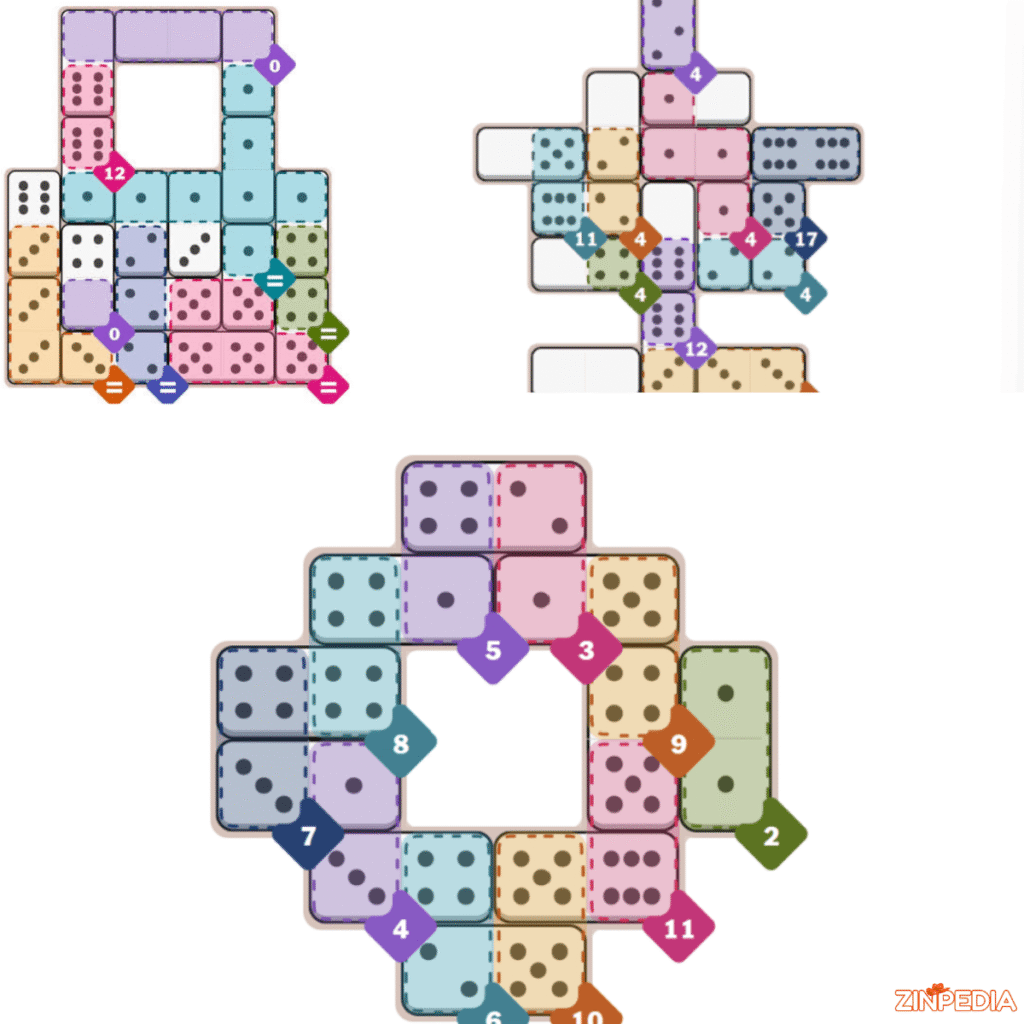
Pips is a domino-placement logic puzzle. Each available domino has two halves, and each half displays a value using dots. Your task is to cover the board while making every colored region follow its own rule.
A completed board must satisfy several conditions at the same time:
- Every square must be covered.
- Every supplied domino must be used.
- Dominoes must remain inside the board.
- Each domino must cover two neighboring cells.
- Every colored region must satisfy its clue.
- No empty cell can be left without a possible partner.
The important point is that Pips is not played like a normal matching-domino game. Two dominoes can touch even when their values are different. The colored clues control the solution, not the values touching along an edge.
Read each clue as a sentence.
Before placing a piece, translate each symbol into simple language.
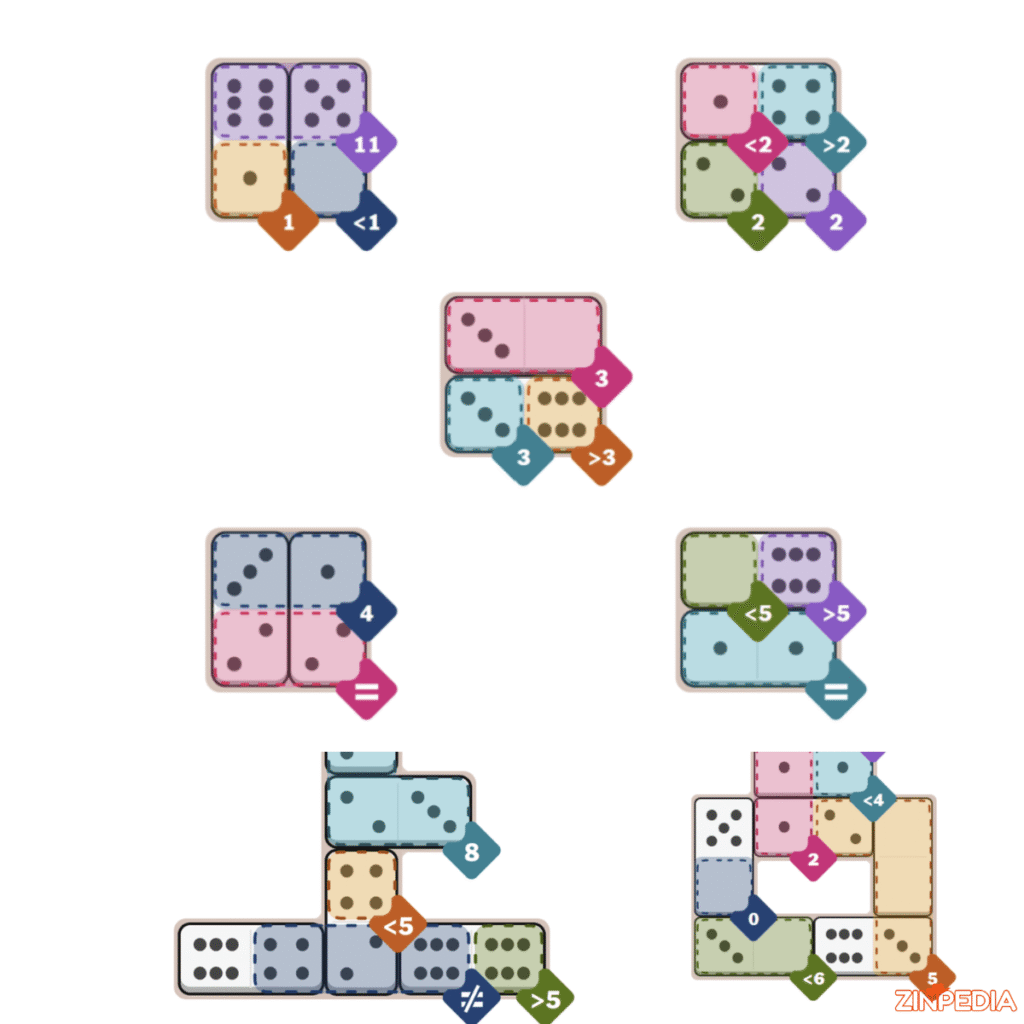
A region displaying a number means:
The values inside this region must add up to that exact number.
A region marked with an equal sign means:
Every value inside this region must be identical.
A region marked with a not-equal sign means:
No value inside this region may be repeated.
A less-than clue means:
The combined total must remain below the shown number.
A greater-than clue means:
The combined total must exceed the shown number.
A blank or unrestricted area does not have an extra mathematical condition. However, it still matters because it must be tiled correctly.
A domino may cross a colored border.
One of the most important Pips rules is that both halves of a domino do not have to remain inside the same region.
For example, imagine a domino showing 2 and 5. The 2 sides could enter a low-total area, while the 5 sides enter a neighboring region that needs a larger value.
This is why solving each colored section separately often fails. The regions are connected by the dominoes that cross between them.
Exact totals do not always reveal complete tiles.
Suppose a region contains three cells and must total 11. Two cells already contain 4 and 5. The missing cell must contain 2.
You now know the required value, but you may not know which domino supplies it. The correct piece could be 2–0, 2–3, or 2–6, depending on the condition beside that empty cell.
Finding the value is only half the deduction. You must also place its partner safely.
Build the Solution From Constraints, Not Guesses
The fastest way to improve at Pips is to stop asking, “Which piece looks right?” and start asking, “Which choice has the fewest alternatives?”
A strong move should come from a restriction.
Begin with the least flexible region.
Some areas can accept many different value combinations. Others can accept only one or two.
Start with regions such as:
- A single-cell exact clue
- A two-cell region with a very high total
- A multi-cell area with a very low maximum
- A large equal region
- A not-equal region using many cells
- A corner that only allows one tile direction
Imagine a two-cell region that must total 12. Because a standard pip value cannot exceed 6, both cells must contain 6.
That deduction is stronger than starting with a four-cell area totaling 10, which may allow many combinations.
Look for rare values in the domino supply.
The board gives you clues, but the available pieces provide another source of information.
Count how often each value appears.
If the puzzle contains only one domino half showing 0, any region that clearly needs a 0 must receive that exact tile.
Similarly, if an equal region contains three cells and only three available halves show 4, those values may belong there.
This method is especially helpful when several mathematical combinations appear possible. The physical tile supply may eliminate most of them.
Compare the whole domino, not only one side.
A common mistake is choosing a piece because one half perfectly satisfies a clue.
Suppose a region needs a 6, and you have two dominoes containing that value:
- 6–1
- 6–5
Both can provide the 6. The better choice depends on where the other half lands.
If the neighboring region must stay below 3, the 6–1 domino is useful. The 6–5 domino would create a problem.
The correct question is not:
Which domino contains the value I need?
It is:
Which domino contains the value I need and also places its second value safely?
Use the board shape as a clue.
Mathematics is only one part of Pips. The shape of the remaining empty cells can force or reject placements.
Every domino covers two adjacent cells. Therefore:
- An isolated square can never be filled.
- A disconnected empty section must contain an even number of cells.
- A narrow passage may force horizontal or vertical placement.
- A corner has fewer possible directions than a central square.
Before locking in a move, check whether the remaining board can still be divided into pairs.
A placement can satisfy every nearby number and still be wrong if it leaves an impossible shape behind.
Use a Pips Hint Ladder Instead of Revealing the Answer
When you become stuck, use hints in stages. Start with a gentle clue and increase the detail only when necessary.
This keeps the puzzle enjoyable and helps you learn from the solution.
Level 1: Review your interpretation
First, confirm that you have not misunderstood a symbol.
Check the following:
- Is the number an exact regional total?
- Does “less than” exclude the boundary number?
- Does “greater than” require a strictly larger total?
- Are all values in a not-equal region different?
- Did you accidentally require touching dominoes to match?
- Did you forget that a tile can cross a region border?
Many boards become solvable immediately after one rule is corrected.
Level 2: Identify the strongest region
Do not move anything yet. Find the area with the fewest possible outcomes.
A useful hint at this stage might be:
- “Focus on the top-left total.”
- “The equal region has only one realistic value.”
- “The narrow column determines a tile’s direction.”
- “The low-sum region must contain a zero.”
This points you toward the next deduction without giving away the exact placement.
Level 3: Identify a required value
If you still need help, calculate one missing pip value.
For example:
- A region totals 13.
- It already contains 5 and 6.
- Its final cell must contain 2.
Knowing the missing value narrows the search but still leaves you to select and orient the domino.
Level 4: Identify the useful domino
The next hint can name the tile without revealing its exact position.
For example:
- “The 2–4 domino is important near the center.”
- “The double-5 cannot remain in the unrestricted area.”
- “The only tile containing 0 must cross a boundary.”
This is a stronger hint, but the final reasoning remains yours.
Level 5: Reveal orientation or location
Only after the earlier levels fail should you reveal where the tile belongs or how it is rotated.
A full board answer should be the final option, not the first.
Using this ladder trains you to recognize patterns. Over time, you will need fewer hints because you will begin asking the same useful questions automatically.
Apply Advanced Pips Strategies on Harder Boards
Medium and Hard puzzles often include several placements that are locally valid. The challenge is finding the arrangement that works across the entire board.
The following methods are especially useful.
Calculate the possible range of a region.
You do not always need the exact total immediately. A minimum or maximum can remove impossible options.
Imagine a four-cell region marked greater than 20.
Four cells can hold a maximum total of 24. Therefore, the region must contain mostly high values. A combination such as 2, 4, 6, and 6 totals only 18 and can be rejected.
Possible patterns may need to include values such as:
- 5, 5, 5, and 6
- 4, 6, 6, and 6
- 5, 5, 6, and 6
This greatly reduces the possible pieces.
Now consider a three-cell region marked less than 4. It must contain a very small combination, such as:
- 0, 0, and 1
- 0, 1, and 2
- 0, 0, and 3
A 4, 5, or 6 cannot appear there at all.
Track values that are already committed
If a region must use three identical values, and you have established that those values are 3, mark every domino half showing 3 as important.
Do not casually use one of those 3s elsewhere until you know enough copies remain.
This is similar to managing limited resources. A value that appears many times is flexible. A value needed in several restricted areas may become scarce.
Use crossing dominoes deliberately.
On difficult boards, the correct solution often depends on a tile satisfying two different regions at once.
Suppose one region requires a 1, while the neighboring region requires a 6. A 1–6 domino may become highly valuable because it solves both requirements in a single placement.
When comparing candidate tiles, prioritize those that contribute useful values on both sides of a border.
Save unrestricted spaces for awkward partners.
Blank areas are useful because any value can be entered into them.
Do not rush to fill those spaces with easy pieces. They may later be needed to receive the unwanted half of a specialized domino.
For example, a 6–0 tile may be the only piece that provides a 6 to a high-total region. The 0 side may need to rest in a blank square because no nearby restricted region can accept it.
Filling that blank square too early can block the only workable placement.
Test the remaining cell count.
After placing a domino, examine the empty board.
If your move creates two disconnected sections, count the cells in each section. Every section must contain an even number because dominoes always cover two cells.
An area containing seven cells cannot be completed independently. That means the last placement was wrong, or the empty sections must still connect in another way.
This technique can eliminate a move without performing any arithmetic.
Use controlled trial and error.
Logical deduction should come first, but Hard puzzles may eventually require testing two possibilities.
When testing:
- Choose a position with only two realistic options.
- Place one candidate.
- Follow its immediate consequences.
- Stop as soon as a contradiction appears.
- Undo the test and use the remaining option.
Do not move several unrelated pieces at once. A controlled test produces information. Random rearranging usually creates confusion.
Fix the Mistakes That Commonly Block the Final Domino
When the last piece does not fit, the problem is rarely the last piece itself. An earlier move usually created the conflict.
Mistake 1: Completing one clue while ignoring another
A domino may finish a total on one side while breaking an equality or inequality condition on the other.
Always verify both halves after placement.
Mistake 2: Treating a legal move as a forced move
A piece may fit physically and satisfy the current numbers, but several other pieces may also work.
Do not become emotionally attached to an early placement just because it has not yet caused a visible error.
Ask whether the move was proven or merely possible.
Mistake 3: Filling open spaces first
Unrestricted cells feel safe, so beginners often place tiles there immediately.
This reduces flexibility and may consume a tile needed by a strict clue later.
Solve restricted areas first and use open spaces to support them.
Mistake 4: Forgetting strict inequalities
A region marked less than 9 cannot total 9.
A region marked greater than 11 cannot total 11.
The boundary value is excluded.
Mistake 5: Allowing repeated values in a unique region
A not-equal region requires every value to be different.
For instance, 1, 3, 3, and 5 are invalid because 3 appears twice.
Mistake 6: Ignoring rotation
A 1–5 domino placed across two regions is not the same as a 5–1 orientation.
The piece may be correct while its direction is wrong.
Mistake 7: Leaving one cell trapped
After every move near an edge, corner, or narrow area, check that each empty square still has at least one adjacent empty partner.
A single trapped cell proves that an earlier placement must change.
Mistake 8: Undoing logical moves before guesses
When correcting the board, remove the weakest assumption first.
Keep placements that were mathematically forced. Reconsider pieces placed only because they appeared convenient.
Frequently Asked Questions
What is a Pips hint?
A Pips hint is a clue that helps you make progress without immediately revealing the complete puzzle solution. It may identify a useful region, required value, important domino, or correct orientation.
How do I solve a Pips puzzle?
Cover the board with all available dominoes while satisfying every colored-region condition. Use exact totals, equality, uniqueness, inequalities, tile availability, and board shape to identify valid placements.
What does a number mean in Pips?
A number inside a colored area is the exact total required from all pip values in that region.
What does the equal sign mean?
Every square inside that region must contain the same value.
What does the not-equal sign mean?
Every value in the region must be different. No pip count may repeat.
What do greater-than and less-than clues control?
They control the combined total of the region. They do not describe each cell.
Do domino values need to match where pieces touch?
No. Pips does not use traditional domino-matching rules. The regional conditions determine whether the board is correct.
Can a domino cover cells from two different regions?
Yes. Many solutions require dominoes to cross colored boundaries.
Which part of the board should I solve first?
Start with the most restricted area. A small exact total, a tight inequality, a large equal region, or a corner often provides the strongest first deduction.
Why does the last domino not fit?
An earlier piece is probably misplaced or incorrectly rotated. Revisit the first move that was possible but not logically forced.
Should I fill blank regions first?
Usually not. Blank cells are flexible and may be needed later to hold the difficult half of a domino used by a restricted region.
How can I solve Hard Pips puzzles?
Track possible totals, count remaining values, use dominoes across boundaries, protect narrow spaces, and check that every disconnected empty area has an even number of cells.
Conclusion
The best Pips hint does not remove the challenge. It helps you see the board more clearly.
Begin by translating every clue into a simple rule. Then search for the region with the smallest number of possible outcomes. Identify required values before selecting complete dominoes, and always check where both halves of a piece will land.
On harder boards, combine arithmetic with spatial reasoning. Count repeated values, protect corners, save unrestricted squares, and watch for odd-sized empty areas. When a contradiction appears, undo your earliest guess rather than dismantling placements supported by logic.
Most importantly, avoid solving the puzzle one region at a time. Every domino connects two spaces, and many pieces connect two different conditions. The correct solution must work as one complete system.
With regular practice, totals, equal-value patterns, forced orientations, and impossible shapes become easier to recognize. Soon, you will need fewer direct answers because the next useful Pips hint will often come from your own reasoning.
Explore More Helpful Articles– Visit Now