

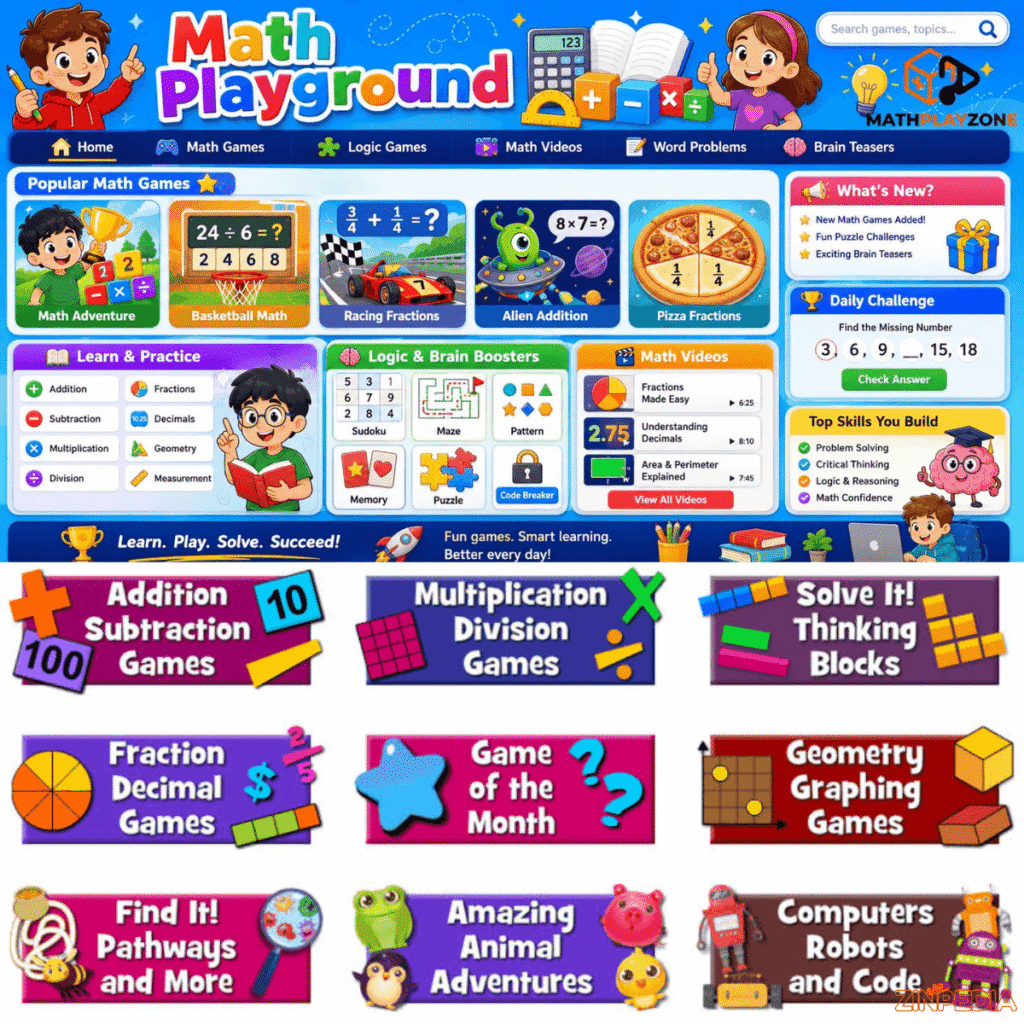
MathPlayground gives children a more enjoyable way to practice mathematics. Instead of completing another page filled with similar questions, learners can work through number games, visual puzzles, logic challenges, and interactive problem-solving activities.
This does not mean that every game automatically improves mathematical ability. The real value depends on how the platform is used. When parents or teachers select activities that match a child’s current learning needs, Math Playground can become a useful practice tool. When children click from one game to another without a goal, the educational benefit may be much smaller.
The platform is mainly designed for elementary-level learners. It includes activities for addition, subtraction, multiplication, division, fractions, decimals, geometry, measurement, word problems, logic, and early algebraic thinking.
For children who find worksheets repetitive, this type of learning can feel more approachable. A multiplication question inside a racing game still requires mathematical thinking, but the game format may make the repetition easier to accept.
This guide explains what Math Playground offers, how children can use it productively, and how adults can turn online play into meaningful learning.
What Is MathPlayground?
MathPlayground is an educational website that combines mathematics with games, puzzles, and interactive activities.
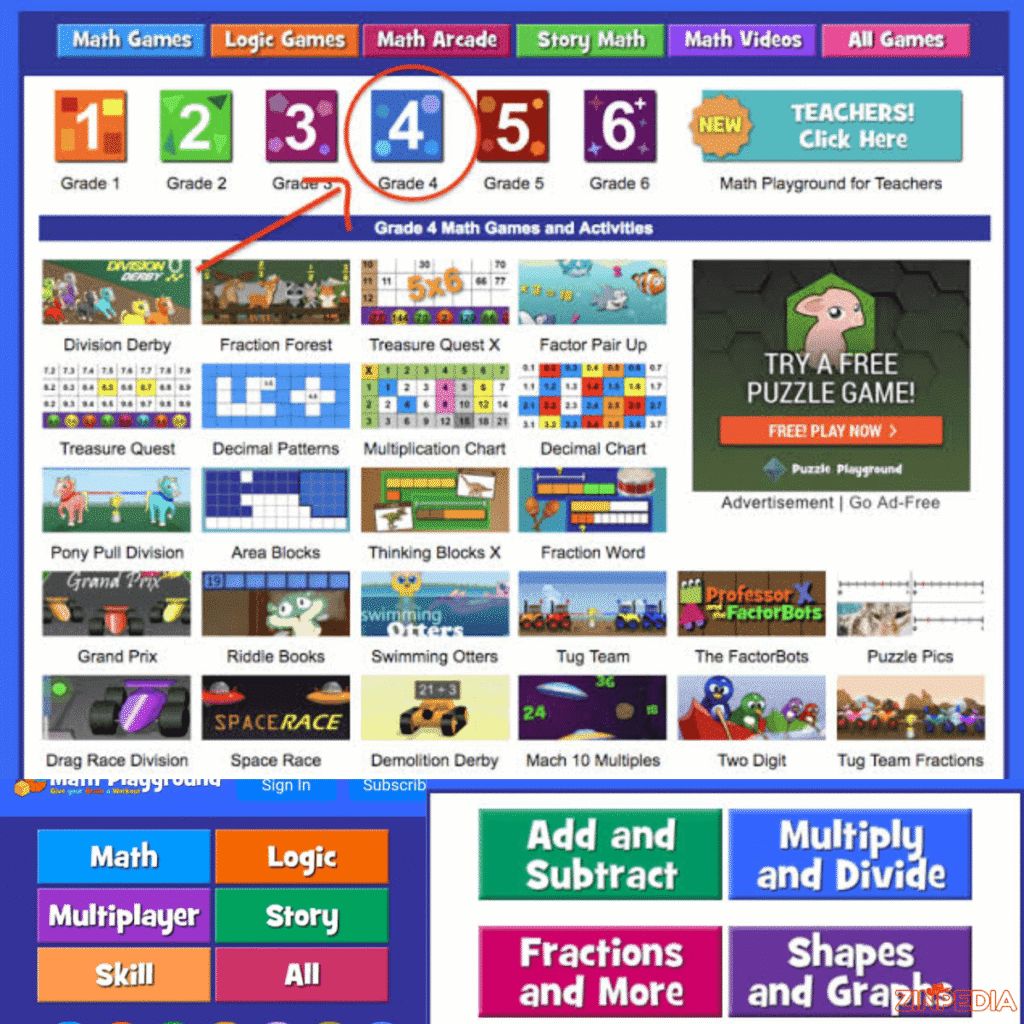
Its content is arranged into categories such as grade-level games, number practice, logic challenges, word problems, visual mathematics, and strategy-based activities. Children can usually begin playing directly in a web browser, which makes the platform easy to use at home or in school.
The website accommodates various learning styles, not just one. Some games emphasize quick calculations, while others encourage children to plan, estimate, recognize patterns, compare quantities, or think multiple steps ahead.
This variety is important because mathematical ability is not only about answering sums quickly.
A child may be confident with multiplication facts but struggle to understand written problems. Another learner may calculate slowly but show excellent spatial reasoning. MathPlayground offers different types of activities, so adults can choose games that fit these different needs.
The platform can be used for:
- Short revision sessions
- Homework support
- Classroom math centers
- Extra practice after a lesson
- Early-finisher activities
- Home-school learning
- Logic and reasoning challenges
It is best viewed as a supplementary resource. It can support learning, but it should not replace clear teaching, discussion, written practice, or real-life mathematical experiences.
What Math Skills Can Children Practice?
MathPlayground covers many of the topics children encounter during elementary school. The exact difficulty varies from one activity to another, so learners do not always need to follow a strict age-based path.
Addition and subtraction
Younger children can practice counting, number recognition, addition facts, subtraction facts, place value, and missing-number problems.
Some activities ask for direct answers. Others present the same skills through puzzles or number-building tasks.
For example, a child may be asked to create a target number using several smaller values. This develops flexible thinking because the learner must consider more than one possible solution.
Instead of memorizing only one fact, the child begins to see how numbers relate to each other.
Multiplication and division
Multiplication games are among the most popular activities on educational websites because they make repeated fact practice feel less monotonous.
Children may race against time, move a character, solve number challenges, or complete levels by answering multiplication questions correctly.
These activities can support fluency, especially when a child already understands what multiplication means.
However, speed should not become the only goal. A learner who quickly guesses answers may appear successful inside a game but still have a weak understanding.
It is helpful to combine online multiplication practice with:
- Arrays
- Groups of objects
- Skip counting
- Number lines
- Real-life sharing examples
Division games can be used in the same way. Children should understand division as sharing, grouping, and the opposite of multiplication, rather than seeing it as an isolated rule.
Fractions and decimals
Fractions often become easier when children can see them.
A written fraction, such as three-fourths, may feel abstract. A visual model divided into four equal parts makes the idea more concrete.
MathPlayground includes activities that may help learners explore:
- Fraction size
- Equivalent fractions
- Fractions on number lines
- Adding and comparing fractions
- Decimal relationships
- Percentages
- Ratios and proportions
Visual games are especially helpful when a child can follow a calculation method but cannot explain why it works.
For example, a learner may know how to find a common denominator without fully understanding why two fractions must be expressed in comparable parts. A visual model can make that relationship clearer.
Geometry and measurement
Geometry activities often involve shapes, angles, area, perimeter, symmetry, coordinates, and spatial movement.
These games can make geometric ideas feel more practical because children are actively moving, rotating, measuring, or arranging objects.
A child may have to:
- Identify a shape
- Complete a pattern
- Measure an angle
- Build a figure from smaller pieces
- Find the perimeter of a space
- Rotate an object into the correct position
This kind of interaction can be more memorable than simply looking at a printed diagram.
Word problems
Word problems are difficult for many children because they require more than calculation.
The learner must read the situation, identify useful information, understand the relationship between quantities, and choose an operation.
Visual problem-solving activities can help children break the question into smaller parts.
Instead of immediately looking for keywords such as “altogether” or “left,” children should ask:
- What do I already know?
- What am I trying to find?
- Which quantities are connected?
- Is one amount part of another?
- Will the answer be larger or smaller?
This process builds stronger reasoning than simply matching words with operations.
Logic and strategy
Some of the most valuable games do not look like traditional math exercises.
Logic puzzles may ask children to follow rules, notice patterns, plan moves, avoid obstacles, or test different solutions.
These activities develop skills that support mathematics, including:
- Concentration
- Planning
- Persistence
- Pattern recognition
- Spatial awareness
- Decision-making
- Error correction
A child who learns to stop, examine a puzzle, and change strategy after a failed attempt is developing a useful mathematical habit.
Why Game-Based Math Practice Can Be Helpful
Children do not all respond to practice in the same way.
Some enjoy workbooks and written exercises. Others lose interest quickly when every question looks similar.
Game-based learning can make repetition easier because it gives the child an immediate purpose. Correct answers may unlock a level, move a character, improve a score, or solve a puzzle.
That extra layer of motivation can encourage children to continue practicing for longer.
It reduces the feeling of repetition.
A child may resist answering 20 multiplication questions on paper but willingly solve the same number during a game.
The mathematical task has not disappeared. It has been placed inside a different experience.
It provides quick feedback.
Most games show immediately whether an answer is correct.
This allows children to adjust quickly rather than completing an entire page before discovering that they misunderstood the method.
Fast feedback is useful, but it should be followed by reflection. Children should understand why an answer was incorrect, not only that it was incorrect.
It encourages experimentation
Logic and strategy games often allow children to try several approaches.
Failure feels less serious because the learner can restart, change direction, and test a new idea.
This can help children become more comfortable with mistakes. In mathematics, that is valuable. Many strong problem solvers learn by testing possibilities, noticing what went wrong, and refining their method.
It supports independent practice.
Once a child understands how to use the website, short practice sessions may require less direct supervision.
This can be useful for parents managing several tasks or teachers working with small groups.
Independence should still have boundaries. Children need a clear activity, a suitable time limit, and occasional adult guidance.
How Parents Can Use MathPlayground Effectively
The easiest mistake is to treat all educational games as equally useful.
A game may look educational because it includes numbers, but that does not automatically mean it matches the child’s learning goal.
Parents can get better results by using a simple routine.
Choose one skill before opening the website.
Decide what the child needs to practice.
The goal might be:
- Multiplication by six
- Subtraction with regrouping
- Equivalent fractions
- Area and perimeter
- Two-step word problems
- Logical reasoning
Once the goal is clear, choose one or two matching games.
This prevents the child from spending most of the session browsing.
Keep sessions short
A focused session of 10 to 20 minutes can be more productive than a long period of random play.
Young children may lose concentration after too much screen time, even when the activity is educational.
A practical routine could look like this:
- Review the skill for two minutes.
- Play one selected game for ten minutes.
- Discuss one example afterward.
- Solve a similar problem without the game.
This final step is important because it shows whether the child can transfer the skill.
Ask children to explain their thinking.
Do not stop at “Did you get it right?”
Ask questions such as:
- How did you find the answer?
- Was there another way to solve it?
- Which part was difficult?
- What mistake did you make?
- What strategy helped you improve?
A child’s explanation often reveals more than the score.
Connect the game to real life.
Online practice becomes more meaningful when children apply the same idea away from the screen.
After a fraction game, divide a pizza, sandwich, or piece of fruit.
After a money activity, count coins or compare prices.
After a measurement game, measure furniture, books, or rooms.
After a multiplication game, create equal groups with small objects.
These simple activities help children understand that mathematics is not limited to websites or schoolbooks.
How Teachers Can Use MathPlayground in Class
MathPlayground can fit into classroom teaching in several ways, but it works best when the teacher provides direction.
Math centers
Teachers can assign one specific game at a digital math center.
The activity should connect directly to the current unit. Students can play for a set amount of time and then complete a short reflection.
For example:
- Write one strategy you used.
- Show one problem on paper.
- Explain one mistake.
- Create a similar question.
This turns game time into accountable learning.
Small-group support
A teacher can use a visual game with students who need additional explanation.
For example, a group struggling with fractions can first discuss a model together. Students can then complete a related activity independently.
The teacher can observe whether learners understand the concept or are simply clicking until they succeed.
Whole-class discussion
Logic games can be projected on a screen and solved as a class.
Students can suggest moves, compare strategies, and explain why one solution may be more efficient than another.
This creates valuable mathematical discussion.
The best part is not always reaching the answer. Listening to different approaches helps students understand that a problem may have more than one solution path.
Early-finisher work
Students who finish classwork early do not always need more questions of the same type.
A logic puzzle, pattern challenge, or spatial game can offer a meaningful extension without feeling like a punishment for working efficiently.
Informal assessment
Teachers can learn a great deal by watching how students play.
Useful observations include:
- Does the student calculate or guess?
- Does the learner notice patterns?
- Can the child explain a strategy?
- Does the student give up quickly?
- Can the learner correct an error?
- Is the difficulty level appropriate?
These observations may reveal learning needs that are not obvious from a final score.
Possible Drawbacks to Consider
MathPlayground can be useful, but it is not perfect.
Advertisements may be distracting.
Free educational websites often use advertising to support operating costs.
Ads can distract children, especially younger learners who may not clearly understand the difference between game content and promotional content.
Parents and teachers should remind children not to click on unfamiliar advertisements or external links.
Some children focus more on the game than the math.
A student may become interested in points, speed, characters, or competition while paying little attention to the underlying skill.
Adults should occasionally pause the activity and ask the child to explain the mathematics involved.
Game success does not always mean mastery.
Children can learn patterns within a particular game.
They may know which button to press or how to predict the game’s design without fully understanding the mathematical concept.
A simple paper question or verbal explanation can confirm whether real learning has occurred.
Too many choices can reduce focus.
A large game library sounds helpful, but it can also create a distraction.
Children may constantly switch activities instead of practicing one skill deeply.
Direct links, bookmarks, or a short approved game list can solve this problem.
It should not replace offline learning.
Mathematics also requires writing, drawing, discussion, mental calculation, physical objects, and real-world application.
Online games should be one part of a balanced learning routine.
Is MathPlayground Worth Using?
MathPlayground can be a strong supplementary resource for children who need additional practice or a break from traditional worksheets.
Its biggest advantage is variety. Children can work on arithmetic, fractions, geometry, logic, word problems, and strategy within the same platform.
The website may be particularly useful for:
- Learners who become bored with repetitive exercises
- Children who benefit from visual examples
- Students who need short daily practice
- Teachers creating digital math centers
- Parents looking for structured educational screen time
- Advanced learners seeking logic challenges
The platform is less effective when children use it without direction.
The key is simple: choose a purpose first, then choose the game.
A short, carefully selected activity followed by a conversation can be far more valuable than an hour of random clicking.
Frequently Asked Questions
Is MathPlayground free to use?
Many activities on MathPlayground can be accessed without payment. The free experience may include advertisements, while paid options may offer additional features or an ad-free environment.
What age group is MathPlayground suitable for?
The platform is mainly designed for elementary school children. However, parents and teachers should choose games based on ability rather than age alone.
Does Math Playground help with multiplication?
Yes. Children can use multiplication games to practice number facts, patterns, factors, arrays, and related division skills.
Can Math Playground help with word problems?
Yes. Visual problem-solving activities can help children organize information, compare quantities, and select suitable operations.
Does a child need an account?
Many games can usually be played without creating a personal account. This makes the website convenient for quick practice.
Can teachers use it in the classroom?
Yes. Teachers can use selected activities for math centers, revision, small-group support, enrichment, and early-finisher tasks.
Is Math Playground safe for children?
It is designed as an educational platform, but adult supervision is still recommended. Children should be taught not to click advertisements, share personal information, or follow unfamiliar links.
Can Math Playground replace regular math lessons?
No. It works best as an extra practice tool. Children still need instruction, written work, feedback, discussion, and real-world mathematical activities.
Conclusion
Math Playground can make elementary mathematics feel more active, visual, and approachable.
Its games give children opportunities to practice essential skills while solving puzzles, making decisions, and learning from mistakes. For some learners, that is enough to make a difficult subject feel less intimidating.
Still, the website should be used with a clear purpose.
Parents and teachers should select activities carefully, keep sessions focused, and ask children to explain what they learned. A game score may show progress, but a child’s explanation shows understanding.
When online games are combined with teaching, conversation, written practice, and real-life examples, Math Playground can become a valuable part of a balanced math-learning routine.
Explore More Helpful Articles– Visit Now